Choosing an accounting firm is an important decision for any growing company. At the beginning, a business may only need someone to record transactions, reconcile the bank account and prepare basic financial reports. As the company grows, however, its accounting requirements usually become more involved.
There may be more customers, more suppliers, additional employees, larger monthly transactions, VAT responsibilities, Corporate Tax requirements, management reporting and new questions about cash flow and profitability.
This is why choosing between accounting firms in UAE should not be based only on the monthly fee.
A good accounting partner should understand how your business operates, maintain reliable financial records, provide reports that management can actually use and help the company prepare for its changing financial and compliance responsibilities.
In the UAE, this has become particularly important as businesses adapt to Corporate Tax requirements, updated rules concerning accounting records and the country’s move toward structured electronic invoicing. The Federal Tax Authority issued Decision No. 4 of 2026 concerning requirements for maintaining information contained in accounting records and commercial books, while the Ministry of Finance continues the phased rollout of UAE e-Invoicing.
For a growing company, the right accounting firm is therefore not simply the company that closes the books every month. It should be a financial partner that helps management understand the numbers and build a stronger financial process.
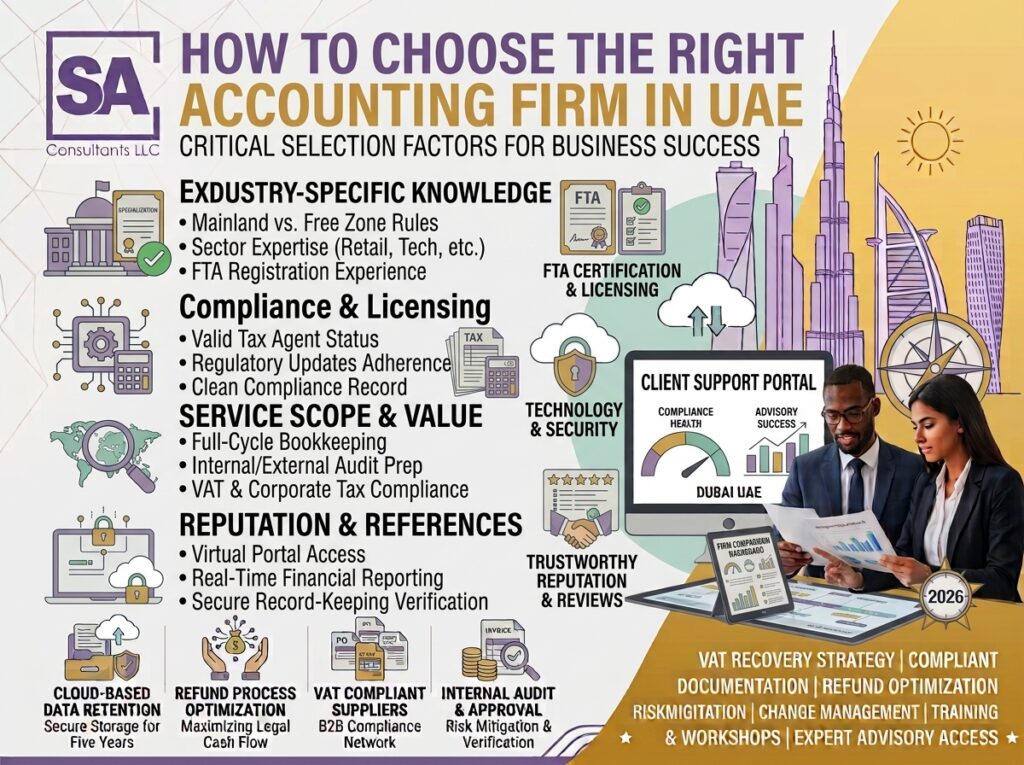
What Should You Look for in an Accounting Firm in the UAE?
The first thing to understand is that not all accounting services are the same.
Some providers focus mainly on bookkeeping. Others offer a broader combination of accounting, tax, payroll, audit support, financial reporting and advisory.
Before making a decision, a business should consider five basic questions:
Does the firm understand my industry?
Can it handle the current transaction volume?
Can it support the business as it grows?
Does it use suitable accounting technology?
Can it help with UAE tax and financial compliance requirements?
These questions are more useful than simply asking how much an accounting package costs.
Accounting Firms in UAE: Start With Your Business Needs
Before speaking to several accounting firms, it helps to understand what the business actually requires.
A small consulting company may need monthly bookkeeping, invoicing, bank reconciliation and management reports.
A trading company may need more detailed purchase, sales, supplier and inventory-related accounting.
An e-commerce company may have payment gateways, refunds, platform fees and several bank settlement accounts that need to be reconciled.
A professional services company may need project or client-level reporting.
A rapidly growing business may need budgeting, cash-flow forecasting and financial modelling in addition to routine accounting.
The right service depends on the business model.
That means a good accounting firm in Dubai UAE should start by asking questions about the company instead of immediately recommending a standard package.
Accounting Companies in UAE: What Services Should Be Included?
When comparing accounting companies in UAE, look carefully at what is actually included.
A basic bookkeeping service may only record transactions.
A broader accounting engagement could include:
Bookkeeping
Regular recording of sales, purchases, expenses, receipts and other financial transactions.
Bank Reconciliation
Matching the accounting records against bank activity and investigating differences.
Accounts Receivable
Tracking customer invoices and outstanding balances.
Accounts Payable
Monitoring supplier bills and amounts due.
Financial Statements
Preparing useful reports such as the profit and loss statement and balance sheet.
Cash Flow Reporting
Helping management understand actual and expected cash movements.
VAT Accounting
Maintaining accounting information that supports applicable VAT processes.
Corporate Tax Support
Providing accounting records and information required to support Corporate Tax compliance and reporting.
Management Reporting
Creating reports that help owners and managers understand business performance.
Year-End Support
Closing accounting records and preparing information required for annual reporting or external professional requirements.
Not every business needs every service.
The important thing is that the provider clearly defines its scope.
Does the Accounting Firm Understand UAE Compliance?
This should be one of the most important checks for a UAE business.
Accounting is not simply about producing a profit and loss statement. Financial records may also support VAT, Corporate Tax and other regulatory processes.
The Federal Tax Authority’s current legislation portal lists FTA Decision No. 4 of 2026 on the rules and requirements for maintaining information contained in accounting records and commercial books. The decision was issued on 2 June 2026 and published by the FTA on 20 August 2026.
That makes record organisation a practical part of accounting rather than an administrative task to worry about later.
A business should ask an accounting provider:
How will our records be stored?
How will supporting documents be attached or maintained?
How are monthly accounts reviewed?
How are reconciliations performed?
How will information be prepared for tax reporting?
These questions help reveal whether the firm has a structured process.
Why Bookkeeping Quality Matters
Bookkeeping sits underneath almost every financial report.
If revenue is recorded incorrectly, the profit figure can be wrong.
If supplier invoices are missing, expenses can be understated.
If bank accounts are not reconciled, the cash position may not be reliable.
If customer balances are not reviewed, management may not know how much money is actually outstanding.
This is why businesses should not treat bookkeeping as the lowest-value part of their finance function.
Good bookkeeping provides the foundation for accounting, tax reporting and management decisions.
For a growing company, the accounting provider should have a repeatable monthly process rather than simply entering transactions whenever someone sends a spreadsheet.
A Practical Monthly Accounting Process
A sensible monthly accounting cycle could look like this:
1. Collect documents
Sales invoices, purchase invoices, receipts, bank information and other supporting records are gathered.
2. Record transactions
Financial activity is entered into the appropriate accounting categories.
3. Reconcile accounts
Bank and other relevant accounts are reconciled.
4. Review receivables and payables
Outstanding customer and supplier balances are reviewed.
5. Check unusual transactions
Large, unusual or incomplete transactions are investigated.
6. Close the month
The accounting records are brought up to date.
7. Prepare reports
Management receives the agreed financial reports.
8. Review the numbers
The business owner and adviser discuss important changes and issues.
This process is much more useful than simply receiving a spreadsheet with hundreds of figures.
Accounting Firms in Dubai: Local Knowledge Matters
A company searching for accounting firms in Dubai is not necessarily looking for someone physically sitting in the same building.
It is usually looking for a provider that understands the Dubai business environment and can communicate efficiently.
The Dubai market includes startups, professional services firms, trading companies, e-commerce businesses, technology companies, construction businesses, hospitality companies and many other industries.
Each business model creates different accounting requirements.
A company operating through a free zone may have different operational considerations from a mainland company.
An e-commerce business may need payment-platform reconciliation.
A consulting company may have a very different cost structure.
A company expanding internationally may need additional attention to cross-border transactions.
Local knowledge is therefore useful, but it should be combined with a clear understanding of the company’s actual financial activity.
What Makes a Good Dubai Accounting Partner?
A good local accounting partner should be able to explain the work in plain language.
You should not have to understand complicated accounting terminology just to know whether your monthly accounts are complete.
The provider should be able to explain:
What changed this month?
Why did profit move?
Which customers have outstanding balances?
What are the largest expenses?
How much cash is available?
What payments are coming up?
Are there unusual transactions?
What financial information needs management attention?
That kind of communication adds much more value than simply sending a report.
Accounting Technology Should Be Part of the Conversation
Another important consideration when comparing accounting companies in UAE is technology.
Modern accounting firms may work with cloud-based platforms that allow financial records, documents and reports to be accessed securely by authorised users.
The technology itself is not necessarily the deciding factor.
The important question is how the system is being used.
A business should ask whether its accounting provider can manage:
- Online invoicing
- Bank feeds
- Automated transaction matching
- Digital expense records
- Document attachments
- User permissions
- Monthly reporting
- Financial dashboards
- Payment reconciliation
- Integration with relevant business systems
SA Consultants’ existing accounting service page lists accounting platforms including FreshBooks, Odoo, QuickBooks, Tally Prime, Wave, Xero and Zoho Books, which is useful context when discussing software-supported accounting workflows.
However, software should support an accounting process rather than replace professional review.
A poorly configured accounting system can still produce poor financial information.
UAE E-Invoicing Is Changing the Accounting Conversation
One of the biggest reasons businesses should think carefully about accounting technology in 2026 is the UAE’s e-Invoicing programme.
The Ministry of Finance defines an e-Invoice as structured invoice data issued and exchanged electronically between a supplier and buyer and reported electronically to the UAE Federal Tax Authority. Ordinary PDFs, Word documents, images, scans and email attachments are not considered e-Invoices under the official definition.
The Ministry launched the UAE e-Invoicing 4-Corner Model in April 2026, allowing businesses to work through accredited channels and begin their e-Invoicing journey.
The programme is being introduced in phases. Official guidance provides different implementation timelines based on the revenue of businesses within scope, with businesses generating annual revenue of AED 50 million or more having a mandatory implementation date of 1 January 2027, and businesses below AED 50 million scheduled for mandatory implementation from 1 July 2027.
The Ministry also announced in May 2026 that the deadline for persons subject to the system with annual revenue exceeding AED 50 million to appoint an Accredited Service Provider was extended to 30 October 2026, while the 1 January 2027 implementation date remained unchanged.
For a growing company, this is not simply an invoicing issue.
It can affect how invoices are created, exchanged, recorded and reconciled.
That means the accounting firm should understand the relationship between invoicing, bookkeeping and the wider accounting system.
Corporate Tax Makes Accurate Accounting More Important
The introduction of UAE Corporate Tax has also changed how businesses think about their financial records.
A company should not view accounting as something that happens after the tax year is finished.
The tax calculation depends on the underlying financial information.
The Federal Tax Authority states that Corporate Tax returns and payments are generally due within nine months from the end of the relevant Tax Period. In September 2026, the FTA specifically reminded taxpayers whose financial year ended on 31 December 2025 that their filing and payment deadline was 30 September 2026.
The FTA has also emphasised the importance of maintaining documents supporting information reported in Corporate Tax returns.
For management, the practical lesson is simple:
Do not wait until the tax deadline to organise your accounting.
Good monthly accounting creates a much better starting point for year-end tax work.
Should Your Accounting Firm Offer Tax Support?
This depends on the business, but it is worth asking.
A company may need both accounting and tax expertise as it grows.
For example, management may need to understand how a transaction is reflected in the financial accounts and how the relevant tax treatment should be considered.
The advantage of using connected services is that the underlying financial information does not have to be repeatedly reconstructed for different advisers.
This does not mean one firm must handle every professional service.
Some businesses may still need separate auditors, tax specialists, legal advisers or other experts.
The key is having clearly defined responsibilities and good communication between the professionals involved.
Financial Reporting: More Than a Profit and Loss Statement
A common weakness in small businesses is receiving financial reports without understanding them.
A monthly profit and loss statement can show revenue and expenses, but management may need additional information to make decisions.
Depending on the company, useful reports can include:
Profit and Loss
Shows revenue, costs and profitability during a period.
Balance Sheet
Shows assets, liabilities and equity.
Cash Flow
Shows how cash is moving through the business.
Accounts Receivable Aging
Shows which customer invoices remain unpaid.
Accounts Payable Report
Shows supplier balances and upcoming obligations.
Budget vs Actual
Compares planned performance with actual results.
Management KPI Report
Tracks the indicators most relevant to the business.
A good accounting provider should help determine which reports are useful rather than producing reports simply because they are standard.
Can Accounting Firms Help With Cash Flow?
Yes, but the level of support varies.
Basic bookkeeping can tell you what transactions have occurred.
Better reporting can show how much customers owe and what expenses are coming up.
More advanced accounting or advisory support can help build cash-flow forecasts.
For a growing company, this can be particularly valuable.
Consider a hypothetical Dubai consulting business with AED 500,000 of invoices issued during a month.
At first glance, AED 500,000 in sales sounds positive.
But if most clients have 60-day payment terms while salaries, office costs, suppliers and other expenses must be paid sooner, the business may experience temporary cash pressure.
Revenue does not automatically equal available cash.
A good accounting process helps management see that difference before it becomes a surprise.
How Much Should an Accounting Firm Be Involved?
There is no single correct answer.
Some businesses want a fully outsourced finance function.
Others have an internal accountant but outsource specialised accounting or tax work.
Some companies only need monthly bookkeeping and reporting.
A growing SME may need a broader finance partner.
The right engagement should match:
Transaction volume
Number of bank accounts
Number of employees
Industry complexity
VAT position
Corporate Tax requirements
Reporting requirements
Growth plans
Internal finance capability
This is why comparing accounting firms based only on price can be misleading.
A low-cost service may be perfectly suitable for a simple business.
A growing company may need a more comprehensive service.
Questions to Ask Before Choosing an Accounting Firm
Before signing an agreement with an accounting provider, ask practical questions.
Who will handle my accounts?
You should know whether the work is handled by a dedicated accountant, a team or a combination of staff.
How often will my books be updated?
Monthly may be sufficient for some businesses, while others need more frequent processing.
What happens if something looks unusual?
There should be a clear process for identifying and discussing unusual transactions.
What reports will I receive?
Ask to see a sample format where possible.
How are bank reconciliations performed?
This can reveal how seriously the firm treats accounting accuracy.
What accounting software do you support?
The answer should reflect your actual business requirements.
Do you support VAT and Corporate Tax accounting?
Understand whether tax support is included, separate or provided through another specialist.
How do you handle year-end?
The transition from monthly bookkeeping to annual accounting should be clear.
How will communication work?
Know how quickly questions are normally handled and who your main contact will be.
Can you scale with the business?
A company that expects growth should not have to change accounting providers every time its transaction volume increases.
Red Flags When Comparing Accounting Firms in UAE
There are also warning signs worth noticing.
The provider promises everything without asking about your business
Accounting requirements differ significantly between industries.
The price is unusually low but the scope is unclear
A low starting price may not include reconciliations, reporting, tax support or year-end work.
You cannot identify who will manage the accounts
Clear responsibility is important.
Reports are delivered without explanation
Management should understand the important movements in its financial information.
The provider relies heavily on manual spreadsheets
Spreadsheets can be useful in specific situations, but a growing business should consider whether its overall accounting workflow is scalable.
Tax and accounting are treated as completely unrelated
The financial records underlying tax reporting need to be accurate and organised.
When Should a Growing Business Change Accounting Firms?
Changing accountants should not be done simply because another provider advertises a lower price.
However, there are situations where a business should reassess its current accounting arrangement.
For example:
The books are consistently behind.
Bank reconciliations are not being completed.
Management reports arrive too late to be useful.
The accountant cannot explain important financial movements.
Tax deadlines create repeated last-minute pressure.
The business has outgrown the existing accounting system.
The accounting firm does not support the company’s new operational requirements.
Communication has become unreliable.
Growth often reveals weaknesses that were not visible when the business was smaller.
Choosing an Accounting Firm for the Next Three Years, Not Just the Next Three Months
One of the best ways to evaluate accounting companies is to think beyond today’s requirements.
Imagine your business grows from five employees to twenty.
Imagine monthly transactions double.
Imagine you open another location.
Imagine you add e-commerce sales.
Imagine you start dealing with larger corporate customers.
Imagine management needs monthly forecasts.
The accounting partner should either be capable of supporting that growth or be transparent about where its service ends.
That is why scalability matters.
A good accounting relationship should reduce financial uncertainty as the business becomes more complicated.
Why SA Consultants Can Be Considered
Businesses looking for accounting firms in UAE can consider providers that combine bookkeeping, financial reporting, tax-related accounting and broader financial support.
SA Consultants’ existing accounting and bookkeeping service covers bookkeeping, financial reporting, tax preparation and compliance, payroll, cash-flow management and outsourced accounting. The page also states that its services are structured for startups, SMEs and larger businesses across industries including trading, hospitality, healthcare, IT, manufacturing and e-commerce.
For a growing business, this broader structure can be useful because accounting requirements rarely remain exactly the same year after year.
A company can begin with monthly bookkeeping and later require stronger management reporting, tax support, cash-flow visibility or more advanced outsourced accounting.
The important consideration is always the actual scope of service agreed with the provider.
A Practical Accounting Firm Selection Checklist
Before making the final decision, a business owner can score each potential provider against a simple checklist.
| Area | What to Look For |
|---|---|
| Industry knowledge | Understands your business model |
| Bookkeeping | Reliable and timely transaction recording |
| Reconciliation | Regular bank and balance reconciliation |
| Reporting | Clear monthly financial reports |
| Tax support | Understands applicable UAE tax processes |
| Technology | Suitable accounting and digital systems |
| Communication | Clear contact and response process |
| Scalability | Can support increased transaction volume |
| Advisory | Can provide useful financial insight where required |
| Transparency | Clear pricing and defined scope |
The provider with the highest score is not necessarily the cheapest.
It is the provider that best fits the company’s actual needs.
Frequently Asked Questions
What should I look for when choosing accounting firms in UAE?
Look for a firm with relevant industry experience, reliable bookkeeping processes, regular reconciliations, clear financial reporting, suitable accounting technology, knowledge of UAE tax requirements and the ability to scale with your business.
What is the difference between accounting companies in UAE and individual accountants?
An accounting company usually provides services through a team or structured practice, while an individual accountant may work independently. The better choice depends on the size and complexity of the business and the level of support required.
How do I choose an accounting firm in Dubai UAE?
Start by reviewing the firm’s experience with businesses similar to yours, service scope, accounting software, reporting process, communication model, tax support and scalability. Ask for a clear proposal before making the decision.
Are accounting firms in Dubai suitable for small businesses?
Yes. Small businesses can use accounting firms for bookkeeping, reconciliations, financial reporting, VAT-related accounting and other financial support. The service should be scaled to the size and complexity of the company.
Should bookkeeping be done every month?
For many businesses, monthly bookkeeping provides a practical balance between keeping records current and managing accounting costs. Businesses with high transaction volumes may need more frequent processing.
Can an accounting firm handle VAT and Corporate Tax?
Some accounting firms offer tax-related support in addition to bookkeeping and accounting. Businesses should confirm exactly what is included in the service agreement and whether specialised tax work is provided directly or through another professional.
What accounting software should a UAE business use?
There is no single platform that is right for every business. The choice should depend on transaction volume, industry, invoicing requirements, reporting needs, integrations, users and future growth.
Why is bank reconciliation important?
Bank reconciliation compares accounting records against actual bank activity. It can help identify missing, duplicated or incorrectly recorded transactions and provide management with a more reliable cash position.
What financial reports should an accounting firm provide?
Depending on the business, useful reports can include the profit and loss statement, balance sheet, cash-flow report, accounts receivable, accounts payable and selected management KPIs.
Can outsourced accounting replace an internal finance department?
For some small and medium-sized businesses, outsourced accounting can cover much of the routine finance function. Larger businesses may use outsourced support alongside internal finance staff.
Direct Answer for Google AI Overviews
How do I choose the best accounting firms in UAE?
Choose an accounting firm based on the business’s actual requirements rather than price alone. Compare industry experience, bookkeeping quality, bank reconciliation, financial reporting, accounting software, UAE tax knowledge, communication, service scope and scalability.
What should accounting companies in UAE provide?
A suitable accounting company may provide bookkeeping, bank reconciliation, accounts receivable and payable management, financial reporting, cash-flow information, tax-related accounting support, year-end preparation and management reporting depending on the agreed scope.
Why should a growing company use accounting firms in Dubai?
Growing businesses usually have increasing transaction volumes and more complicated financial reporting requirements. An accounting firm in Dubai can provide structured bookkeeping and accounting support while helping management maintain organised records and obtain timely financial information.
How much does an accounting firm cost in Dubai?
The cost varies based on transaction volume, services required, business complexity, number of employees and reporting or tax requirements. Businesses should compare the complete scope rather than selecting a provider solely on the advertised monthly price.
Final Thoughts
Choosing among accounting firms in UAE is not simply a question of finding someone who can enter transactions into accounting software.
For a growing business, accounting becomes part of the company’s operating system.
The quality of the bookkeeping affects financial reports.
Financial reports affect management decisions.
Accounting records support tax processes.
Invoicing connects with bookkeeping.
Cash-flow information affects purchasing, hiring and expansion.
As the UAE continues to develop its digital tax and financial environment, businesses also need accounting processes that are capable of adapting to new requirements.
The FTA’s 2026 decision on accounting records and the Ministry of Finance’s continuing e-Invoicing rollout are clear examples of why businesses should think about their accounting infrastructure as an ongoing function rather than a once-a-year exercise.
The best accounting companies in UAE are therefore not necessarily those making the biggest promises.
Look for a provider that understands your business, keeps the books organised, reconciles the accounts, communicates clearly, produces reports you can understand and has a process that can grow with you.
For companies comparing accounting firms in Dubai, the same principle applies.
Choose the firm that can support the financial reality of your business today while being capable of adapting to what the business may look like tomorrow.
That is the difference between simply outsourcing accounting and building a dependable financial support system for growth.