Can a Supplier Affect Your UAE VAT Recovery?
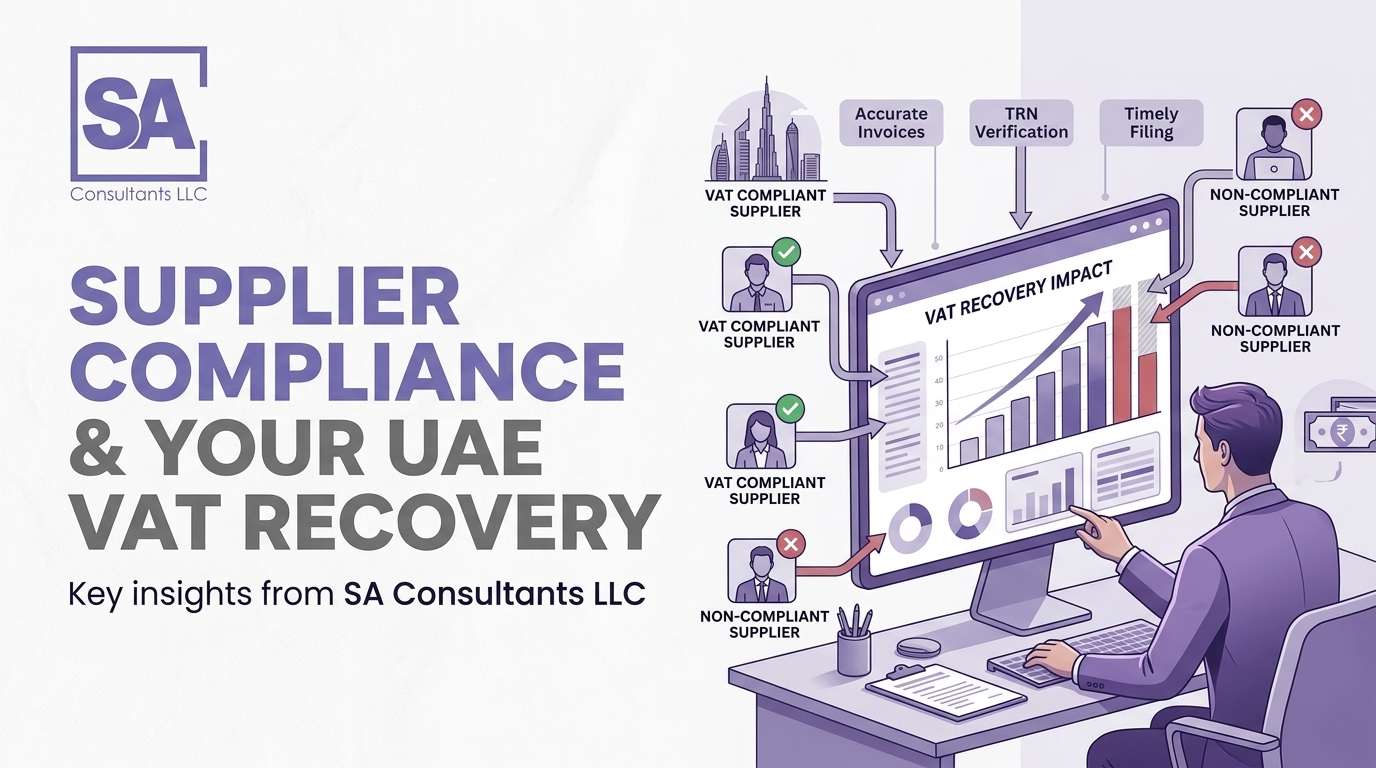
Yes, your supplier can affect how confidently your business can claim input VAT.
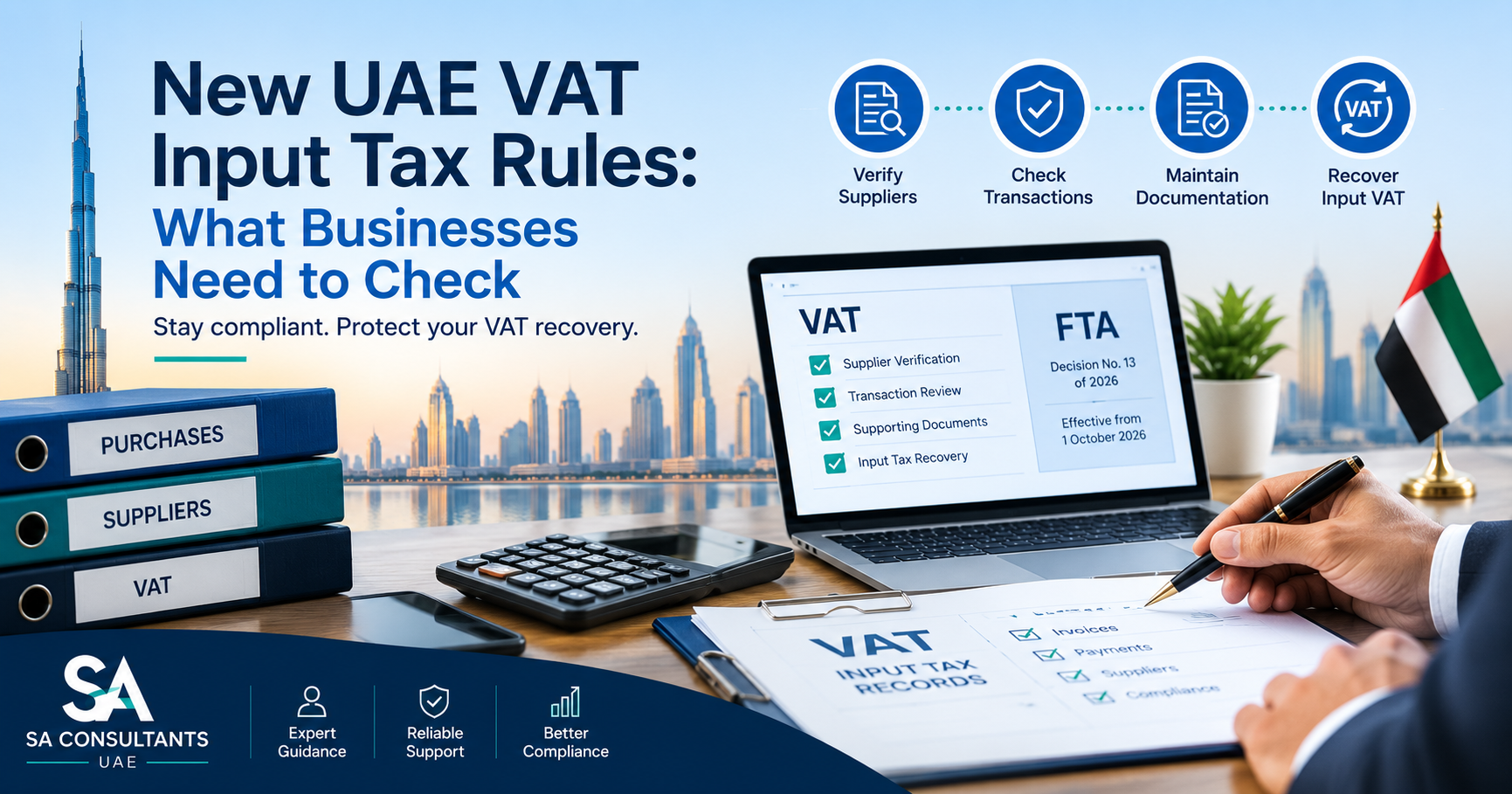
Under FTA Decision No. 13 of 2026, UAE taxable persons must take specified measures to verify the validity and integrity of supplies before deducting input tax. The decision takes effect on October 1, 2026.
This means VAT compliance is no longer something businesses should think about only when preparing the VAT return.
The supplier, the transaction, payment method, supporting documents and commercial circumstances all form part of the picture.
For a Dubai SME, this makes supplier onboarding and bookkeeping more important than ever.
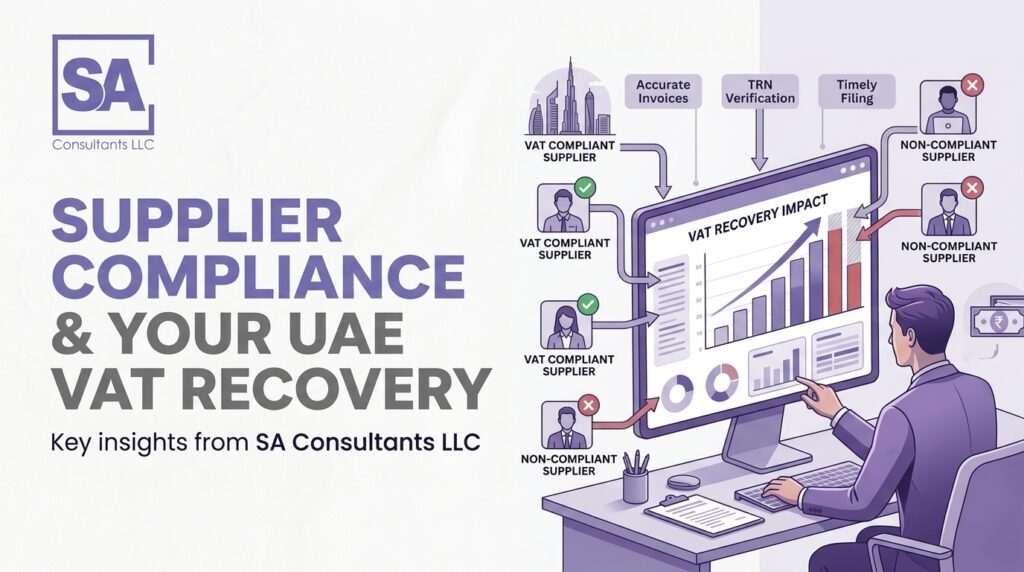
Why Does Your Supplier Matter for UAE VAT Recovery?
When a business purchases goods or services, it may be entitled to recover eligible input VAT.
But the VAT invoice is only part of the transaction.
Businesses should also be able to demonstrate that the underlying supply is genuine and properly supported.
The new FTA decision specifically addresses verification of the supplier and the supply received before input tax deduction.
A Simple Example
Imagine a Dubai company purchases AED 300,000 of equipment from a new supplier.
The supplier provides a VAT invoice showing AED 15,000 of VAT.
The accounting team may normally record the invoice and include the input VAT in the next return.
Under the new verification framework, the business should also consider:
- Who is the supplier?
- Is the supplier a genuine business?
- Does the supplier have an appropriate business presence?
- Does the transaction make commercial sense?
- Are the goods authentic?
- How was payment made?
- Are the supplier’s activities consistent with the goods or services supplied?
- Can the company produce evidence of its checks?
That is the practical meaning of VAT due diligence UAE businesses should prepare for.
What Is Input VAT Recovery in the UAE?
Input VAT is the VAT a business pays on purchases and expenses.
Where the legal requirements for recovery are satisfied, eligible input VAT can generally be deducted from output VAT when calculating the VAT payable.
For example:
Output VAT: AED 50,000
Eligible Input VAT: AED 20,000
Net VAT payable: AED 30,000
The figures above are simply an example.
The important issue is whether the input VAT being claimed is properly supported and eligible for recovery.
That is why accurate accounting records, tax invoices and supplier documentation matter.
What Does FTA Decision No. 13 of 2026 Require?
The decision establishes measures and conditions that taxable persons must follow when verifying suppliers and supplies before deducting input tax.
The requirements can be grouped into five practical areas:
- Supplier verification
- Supplier risk assessment
- Transaction verification
- Payment verification
- Documentation and internal controls
Let’s look at each one.
1. Verify Your Supplier
The first step is knowing who you are buying from.
For a natural-person supplier, the decision requires obtaining valid proof of identity, such as an Emirates ID or passport, and meeting the supplier either physically or virtually before the supply.
For a legal entity, the taxable person must verify incorporation through official databases or obtain relevant incorporation documentation.
The identity of the authorised director, agent or employee representing the supplier must also be verified.
What This Means for Businesses
Don’t treat supplier onboarding as simply:
Name → Email → Invoice → Payment
A stronger process is:
Supplier details → Verification → Approval → Purchase → Invoice → Payment → Records
This creates a clearer audit trail.
2. Check the Supplier’s Business Address
The FTA decision also requires taxable persons to verify the supplier’s address and place of business.
The existence of an actual business location should be verified using appropriate electronic means or through a field visit.
The location should also be compatible with the nature of the supplier’s business activities.
Why Is This Important?
Consider a supplier claiming to operate a large distribution business.
If the supplier’s business presence does not appear consistent with the size or nature of the operation, that may require further investigation.
It does not automatically mean the supplier is non-compliant.
It means the transaction deserves appropriate verification.
3. Watch for Supplier Risk Indicators
The new rules identify several risk indicators.
Businesses should pay attention when a supplier:
- Changes its address more than twice within 12 months
- Changes key employees more than twice within 12 months
- Carries out transactions that appear disproportionate or unexpected compared with the size or history of the business
If one of these indicators applies, the taxable person should retain a clear and justified explanation, provided it does not conflict with available evidence or information.
Practical Example
A supplier has suddenly moved offices twice and changed its key contacts several times.
That does not automatically invalidate your purchase.
But your business should understand what happened and retain an appropriate explanation if the situation falls within the specified risk indicators.
4. High-Value Suppliers Need Additional Attention
The decision includes a specific threshold.
If supplies received from a supplier exceed AED 375,000 during the previous 12 months, or are expected to exceed AED 375,000 during the next 12 months, additional checks apply.
These include verifying that the supplier has a bank account and reviewing available client recommendations.
Example
Suppose a construction company purchases:
AED 420,000 of materials from Supplier A over 12 months.
The company should consider the additional supplier verification requirements applicable to that threshold.
This is particularly relevant to businesses with:
- Large procurement volumes
- Construction projects
- Trading operations
- Manufacturing
- Wholesale businesses
- High-value professional services
5. Does the Transaction Make Commercial Sense?
Supplier verification is only half of the process.
The business must also assess the actual supply.
The FTA decision requires a general assessment of the transaction and whether the supplier’s involvement is based on genuine commercial reasons.
Ask:
What was purchased?
Does the invoice clearly describe the goods or services?
Why was it purchased?
Is there a genuine business reason?
Who supplied it?
Does the supplier normally provide this type of product or service?
Was the transaction actually completed?
Can you show delivery records, contracts, work completion evidence or other relevant documentation?
These questions help establish a stronger VAT audit trail.
6. Payment Method Can Matter
The decision also addresses payment conditions.
The payment method and conditions should be commercially justifiable.
If a third party is involved in payment, or payment is made to a bank account outside the supplier’s country of incorporation, there should be a reasonable commercial explanation that does not conflict with available evidence.
The decision also states that consideration should be paid electronically.
Where cash is used, there must be a documented commercial reason, the payment must remain within applicable tax-law thresholds and it must be easily verifiable.
Best Practice
Keep the transaction trail together:
Purchase Order
↓
Tax Invoice
↓
Delivery / Service Evidence
↓
Payment Record
↓
Accounting Entry
↓
VAT Return
This makes it much easier to explain a transaction later.
7. Can Unusual Pricing Create a VAT Compliance Issue?
It can trigger additional questions.
The FTA decision requires businesses to verify that prices or profit margins are not commercially unjustifiable or significantly different from market conditions without a clear reason.
This does not mean every transaction must have the lowest market price.
There may be legitimate reasons for paying more:
- Urgent delivery
- Better quality
- Specialised products
- Customisation
- Warranty
- Limited availability
- Better service levels
The important point is that unusual pricing should have a reasonable commercial explanation.
8. Does the Supplier Actually Provide the Product or Service?
Businesses should verify that the goods or services supplied do not fall outside the supplier’s ordinary business activities or the activities the supplier is licensed to conduct.
Example
An IT consultancy normally provides software development services.
It suddenly issues a large invoice for unrelated physical goods.
That does not automatically make the transaction invalid.
But it is reasonable for the purchasing business to ask:
Why is this supplier providing these goods?
A documented commercial explanation can help clarify the transaction.
9. Check the Authenticity and Origin of Goods
For goods, the decision also requires verification of:
- Authenticity
- Origin
- Supplier ownership
- Supplier’s right to dispose of the goods
This can be particularly important for businesses involved in:
- Electronics
- Luxury goods
- Automotive products
- Trading
- Wholesale
- Import and distribution
The larger the transaction, the more important a clean documentation trail becomes.
10. Keep Evidence of Your VAT Due Diligence
This is one of the most practical parts of the new framework.
The FTA decision requires businesses to document the verification steps they take and retain supporting documents and records.
Businesses must also maintain a documented policy identifying who is responsible for:
- Implementing verification
- Reviewing verification
- Supervising verification
- Carrying out the relevant responsibilities
The policy should clearly identify powers and responsibilities.
In Simple Terms
Your business should be able to answer:
Who checks suppliers?
Who approves them?
Who reviews high-risk transactions?
Where is the evidence stored?
Who is responsible for the process?
How Often Should You Verify a Supplier?
The decision states that supplier verification should take place when dealing with a supplier for the first time.
It should also be repeated for recurring dealings when the supplier has not been verified during the previous 12 months.
Each taxable supply received must also be verified according to the relevant supply requirements.
This makes supplier review something that should become part of the normal accounting workflow.
Is There an Exception for Small Purchases?
Yes.
The decision allows taxable persons to disregard the specified verification measures for taxable supplies where the consideration, excluding VAT, is less than AED 10,000.
However, this exception does not apply when the total value of supplies received from the same supplier exceeds AED 100,000 during the previous 12 months, or is expected to exceed that amount during the next 12 months.
So businesses should not look at the AED 10,000 transaction threshold without also considering the supplier’s overall purchasing history.
What Should Dubai Businesses Do Before October 2026?
The effective date is October 1, 2026, so businesses should review their processes now.
A practical preparation checklist is:
Supplier Checklist
- Verify new suppliers
- Review supplier identity
- Check business address
- Review business activities
- Monitor supplier risk indicators
- Track high-value suppliers
Transaction Checklist
- Confirm the purchase is commercially genuine
- Match invoices with purchases
- Keep delivery evidence
- Review unusual pricing
- Verify goods where applicable
Payment Checklist
- Prefer electronic payments
- Keep payment records
- Document unusual payment arrangements
- Explain third-party payment arrangements where applicable
Documentation Checklist
- Keep supplier verification records
- Keep invoices
- Keep contracts
- Keep purchase orders
- Keep delivery records
- Keep payment evidence
- Maintain an internal verification policy
How Good Bookkeeping Supports VAT Recovery
A business may have strong supplier relationships and still struggle with VAT compliance if its accounting records are poorly organised.
For example, imagine a company has:
- Invoices in email
- Purchase orders in WhatsApp
- Payment records in online banking
- Delivery notes in a filing cabinet
- Supplier information in Excel
- VAT records in accounting software
The transaction may be legitimate, but proving it can become unnecessarily difficult.
Good bookkeeping brings these pieces together.
For UAE businesses, this can help with:
- Input VAT tracking
- Supplier reconciliation
- Invoice verification
- Payment matching
- VAT return preparation
- Audit documentation
- Monthly financial reporting
A Simple Supplier VAT Review Process
Businesses don’t need to make the process unnecessarily complicated.
A simple workflow can look like this:
Step 1 — Supplier Onboarding
Collect and verify supplier information.
Step 2 — Supplier Risk Review
Check relevant risk indicators.
Step 3 — Purchase Review
Confirm the purchase has a genuine commercial purpose.
Step 4 — Invoice Review
Check the tax invoice and transaction details.
Step 5 — Payment Review
Match the payment with the supplier and transaction.
Step 6 — Documentation
Store the evidence in one organised location.
Step 7 — VAT Review
Confirm the transaction is appropriately treated before input VAT is included in the return.
This process can be incorporated into the company’s normal accounting workflow.
Common VAT Recovery Mistakes to Avoid
Mistake 1: Assuming a VAT Invoice Is Enough
A tax invoice is important, but the business should also consider the underlying transaction.
Mistake 2: Never Reviewing Suppliers
Supplier information should not be treated as permanently valid.
Mistake 3: Ignoring Unusual Transactions
Unexpected transaction values or activities deserve appropriate attention.
Mistake 4: Poor Payment Documentation
A business should be able to demonstrate how a transaction was paid.
Mistake 5: No Internal Responsibility
Someone should be clearly responsible for supplier and transaction verification.
Mistake 6: Waiting Until the VAT Return
Trying to reconstruct documentation at the end of a VAT period creates unnecessary pressure.
What Does This Mean for UAE SMEs?
For small businesses, the biggest challenge is usually not understanding the concept.
It is building a process that employees actually follow.
You do not need to turn every small purchase into a complicated investigation.
Instead, create clear rules for:
- New suppliers
- High-value suppliers
- Unusual transactions
- Higher-risk purchases
- Supporting documentation
- Monthly VAT review
This creates a more practical approach to input VAT recovery UAE businesses can maintain over time.
How SA Consultants UAE Can Help
VAT compliance is closely connected to accounting and bookkeeping.
If supplier information, invoices, payments and supporting documents are properly organised, businesses have a stronger foundation for VAT reporting and recovery.
SA Consultants UAE helps businesses with accounting, bookkeeping, VAT and tax compliance processes designed around their operational needs.
For businesses in Dubai and across the UAE, professional accounting support can help reduce the risk of missing documentation, incorrect VAT treatment and last-minute compliance work.
Frequently Asked Questions
Can a supplier affect UAE VAT recovery?
Yes. Under FTA Decision No. 13 of 2026, taxable persons must take specified measures to verify the validity and integrity of supplies before deducting input tax.
When do the new supplier verification rules take effect?
FTA Decision No. 13 of 2026 takes effect on October 1, 2026.
What should businesses check about a supplier?
Businesses should verify relevant supplier identity, business address, place of business and specified risk indicators. Additional checks apply to suppliers above the AED 375,000 threshold described in the decision.
What is the AED 375,000 supplier threshold?
Where supplies received from a supplier exceed AED 375,000 in the previous 12 months or are expected to exceed that amount in the next 12 months, additional supplier checks apply, including bank-account verification and review of available client recommendations.
Is there an exception for purchases below AED 10,000?
Yes, the specified verification measures may be disregarded for taxable supplies below AED 10,000 excluding VAT, subject to the AED 100,000 supplier-level condition in the decision.
Does payment method matter for VAT due diligence?
Yes. The decision requires payment methods and conditions to be commercially justifiable and generally requires consideration to be paid electronically, with specific conditions applying to cash payments.
How often should supplier verification be performed?
Supplier verification is required when dealing with a supplier for the first time and again for recurring dealings where the supplier has not been verified during the previous 12 months.
Why is bookkeeping important for VAT recovery?
Accurate bookkeeping helps businesses connect supplier information, invoices, purchases, payments and supporting records, making VAT reporting and documentation easier to manage.
Final Takeaway
Your supplier does not simply provide an invoice.
The supplier forms part of the transaction that supports your input VAT claim.
From October 1, 2026, UAE businesses need to pay closer attention to supplier and supply verification under FTA Decision No. 13 of 2026.
The best approach is not to wait for a VAT review or audit.
Build the checks into your normal accounting process now.
Verify the supplier.
Understand the transaction.
Keep the evidence.
Document the process.
Review input VAT carefully before filing.
That is a much stronger approach to UAE VAT recovery and overall tax compliance.