What Are the New UAE VAT Input Tax Rules?
Businesses registered for VAT in the UAE need to pay closer attention to how they verify suppliers and purchases before claiming input VAT.
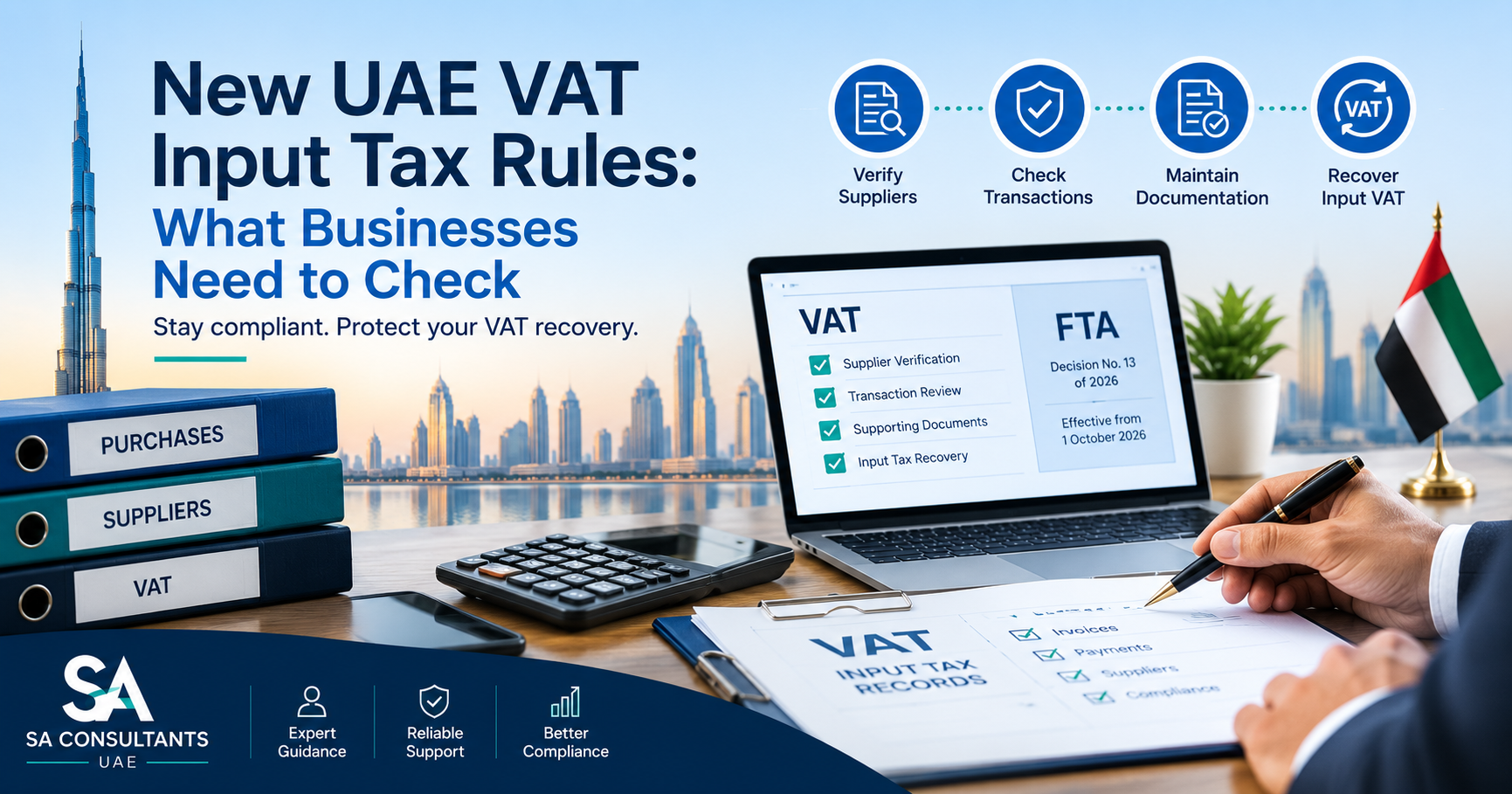
The Federal Tax Authority issued Decision No. 13 of 2026, which sets out measures, procedures and conditions for taxable persons to verify the validity and integrity of supplies before deducting input tax. The decision was issued on July 22, 2026 and becomes effective on October 1, 2026.
In simple terms, businesses should not treat every VAT invoice as automatically sufficient for input tax recovery.
They need appropriate checks around the supplier, transaction, payment and nature of the supply, while keeping supporting evidence.
For UAE businesses, this makes good bookkeeping and VAT documentation even more important.
Why Do the New VAT Rules Matter for UAE Businesses?
Input VAT can directly affect a company’s cash flow.
For example, imagine a Dubai trading company purchases AED 200,000 of goods plus VAT from a supplier. The company expects to recover the VAT through its VAT return.
But what happens if the supplier information is inconsistent, the transaction looks unusual, or the business cannot demonstrate appropriate verification?
This is why businesses should strengthen their VAT compliance UAE processes rather than checking invoices only at the end of the VAT period.
The new framework places specific verification expectations on taxable persons before deducting input tax.
What Does Input VAT Mean in the UAE?
Input VAT is the VAT a business pays on eligible purchases of goods or services.
For example:
- Office equipment purchased for the business
- Professional services
- Business-related supplies
- Certain operating expenses
- Goods purchased for taxable business activities
Where the relevant legal requirements are met, the business may recover eligible input VAT through its VAT return.
The important point is that VAT recovery is not simply about having an invoice.
Businesses also need reliable records demonstrating that the underlying transaction is genuine and properly supported.
What Changes Under FTA Decision No. 13 of 2026?
The decision establishes specific measures for verifying the validity and integrity of supplies before input tax deduction.
The requirements cover several areas.
1. Supplier Verification
Businesses need to verify the identity of their suppliers.
For an individual supplier, the decision refers to obtaining valid proof of identity and meeting the supplier in person or virtually before the supply.
For a legal entity, businesses need to verify its incorporation through official databases or appropriate incorporation documents and verify the identity of the authorised representative.
Practical Example
A company in Dubai starts purchasing high-value equipment from a new supplier.
Instead of simply entering the supplier into the accounting system and processing the invoice, the company should have a documented onboarding process covering the supplier’s identity and business information.
This creates a stronger audit trail.
2. Verify the Supplier’s Business Address
The new UAE VAT input tax rules also require verification of the supplier’s address and place of business.
Businesses should verify that an actual place of business exists.
This can involve appropriate electronic verification or a field visit.
The business should also consider whether the supplier’s premises are compatible with the nature of the activities it claims to conduct.
Why This Matters
Suppose a supplier claims to operate a substantial goods distribution business but has no credible business presence that matches the scale or nature of its activities.
That may warrant additional checks before relying on the transaction for VAT recovery.
3. Pay Attention to Supplier Risk Indicators
The decision identifies specific risk indicators businesses should consider.
These include situations where:
- A supplier changes its address more than twice within 12 months
- Key supplier employees change more than twice within 12 months
- The supplier conducts transactions that appear disproportionate or unexpected compared with its business size or history
Where such indicators exist, the taxpayer should retain a clear and justified explanation, provided the explanation is consistent with available evidence.
This does not mean every supplier with a changing address or staff automatically creates a VAT problem.
The practical lesson is to identify unusual circumstances and document why the business proceeded.
4. Higher-Value Suppliers Require Additional Checks
There is a specific threshold for certain supplier checks.
Where the value of supplies received from a supplier exceeds AED 375,000 during the previous 12 months, or is expected to exceed AED 375,000 during the next 12 months, the taxable person must verify that the supplier has a bank account and review available client recommendations.
Businesses should therefore consider adding supplier-value monitoring to their accounting procedures.
A Simple Internal Process
Your accounts team could maintain a supplier review list showing:
| Supplier | 12-Month Purchases | Risk Review | Bank Verification | Status |
|---|---|---|---|---|
| Supplier A | AED 420,000 | Completed | Completed | Active |
| Supplier B | AED 175,000 | Standard | N/A | Active |
| Supplier C | AED 390,000 | Pending | Pending | Review |
The exact internal format can vary, but the goal is to make verification traceable.
5. Review the Actual Transaction
Supplier verification is only one part of the process.
Businesses also need to assess the supply itself.
The decision requires a general assessment of the transaction and whether the supplier’s involvement is based on genuine commercial reasons.
Ask practical questions such as:
- What was purchased?
- Why was it purchased?
- Who supplied it?
- Does the purchase make commercial sense?
- Was the price reasonable?
- Does the supplier normally provide this type of product or service?
- Is there evidence that the goods or services were actually supplied?
These questions can become part of a company’s internal VAT compliance UAE checklist.
6. Check Payment Conditions
Payment arrangements can also matter.
The decision states that payment methods and conditions should be commercially justifiable.
Where a third party is involved in payment or payment is made to a bank account outside the supplier’s country of incorporation, there should be a reasonable commercial explanation that does not conflict with available evidence.
The decision also states that consideration should be paid electronically, while cash payments must have a documented commercial reason, remain within applicable tax-law thresholds and be easily verifiable.
Practical Tip
Keep supporting documents together:
Purchase Order → Invoice → Delivery Evidence → Payment Record → Accounting Entry
This makes the transaction easier to explain if questions arise later.
7. Check Whether the Price Makes Commercial Sense
Another important area is the commercial reasonableness of the transaction.
Businesses should consider whether the price or profit margin is commercially justifiable and whether it differs significantly from market conditions without a clear reason.
This does not mean every purchase must have the cheapest market price.
There may be perfectly legitimate reasons for a higher price, such as:
- Better quality
- Urgent delivery
- Specialised services
- Longer warranty
- Location
- Customisation
- Limited availability
The important point is being able to explain unusual pricing when necessary.
8. Make Sure the Supplier’s Activity Matches the Supply
Businesses should also verify that the goods or services received do not fall outside the supplier’s ordinary business activities or the activities permitted under its commercial licence.
For example, if a company normally provides IT consulting but suddenly issues a large invoice for unrelated goods, the transaction may deserve additional review.
Again, the purpose is not to reject legitimate transactions automatically.
It is about identifying transactions that require stronger evidence.
9. Verify Goods and Their Origin
For goods, businesses should consider evidence relating to:
- Authenticity
- Origin
- Supplier ownership
- The supplier’s right to dispose of the goods
These checks can be especially relevant for businesses involved in trading, distribution and high-value goods.
A strong purchasing process should therefore go beyond simply saving a PDF invoice.
10. Document Your VAT Verification Process
This may be one of the most important practical steps for UAE businesses.
The decision requires taxable persons to document verification steps and retain supporting documents and records.
It also requires a documented policy identifying the people responsible for implementing, reviewing and supervising the verification procedures.
In other words, businesses should know:
Who checks the supplier?
Who reviews unusual transactions?
Who approves the purchase?
Where is the evidence stored?
Who reviews the process?
A documented process can make VAT compliance much easier to manage.
Are There Exceptions to the New UAE VAT Verification Requirements?
Yes.
The decision allows taxable persons to disregard the specified verification measures for taxable supplies where the consideration, excluding VAT, is less than AED 10,000.
However, that exception does not apply where the total value of supplies received from the supplier exceeds AED 100,000 during the previous 12 months, or is expected to exceed that amount during the next 12 months.
This means businesses should not interpret the AED 10,000 threshold in isolation.
Supplier-level purchasing history also matters.
What Should UAE Businesses Do Before October 1, 2026?
The effective date is approaching quickly.
Businesses should use September to review their current purchasing and VAT processes.
VAT Compliance Checklist
Supplier Records
- Verify supplier legal information
- Check supplier identity
- Verify business address
- Review commercial licence information where relevant
- Maintain supplier onboarding records
Transaction Records
- Keep purchase orders
- Keep tax invoices
- Keep delivery documents
- Keep contracts where applicable
- Maintain payment evidence
- Document unusual transactions
Risk Review
- Identify high-value suppliers
- Monitor unusual supplier changes
- Review unusual transaction values
- Check whether the supply matches the supplier’s activities
- Document explanations for legitimate unusual circumstances
Internal Controls
- Assign responsibility for supplier verification
- Create a documented VAT verification policy
- Train accounting staff
- Keep evidence in an organised location
- Review the process periodically
How Better Bookkeeping Supports UAE VAT Compliance
VAT compliance starts long before a VAT return is submitted.
If purchase invoices, supplier records, payments and supporting documents are scattered across email accounts, WhatsApp conversations and spreadsheets, it becomes difficult to establish a clean audit trail.
Good bookkeeping brings these records together.
For Dubai SMEs, a structured monthly accounting process can help the business:
- Reconcile supplier transactions
- Track input VAT
- Identify missing invoices
- Match invoices with payments
- Review unusual expenses
- Prepare VAT records
- Maintain supporting documentation
This is where professional bookkeeping can provide practical value beyond simply recording transactions.
What Should Businesses in Dubai Do Differently?
Dubai businesses often work with multiple suppliers, contractors, distributors and service providers.
That makes supplier due diligence particularly important for companies with high transaction volumes.
A growing Dubai business should consider creating a simple supplier verification workflow:
New Supplier → Verification → Approval → Purchase → Invoice → Payment → Record Keeping → Periodic Review
This creates consistency without turning every purchase into a complicated administrative exercise.
Common Mistakes Businesses Should Avoid
Mistake 1: Checking Only the VAT Invoice
A valid-looking invoice is important, but businesses should also consider the underlying transaction and supplier.
Mistake 2: No Supplier Onboarding Process
If anyone in the company can add a new supplier without verification, compliance risks can increase.
Mistake 3: Poor Documentation
A business may have performed appropriate checks but still struggle if there is no evidence showing what was checked.
Mistake 4: Ignoring High-Value Suppliers
Supplier transaction values should be monitored because additional requirements apply at specified thresholds.
Mistake 5: Treating All Transactions the Same
Higher-risk or unusual transactions may require additional review.
Mistake 6: Leaving VAT Review Until Filing Time
By the time the VAT return is being prepared, it may be difficult to reconstruct missing documentation.
Monthly review is much easier.
What Does This Mean for Small and Medium Businesses?
The new requirements may sound complicated, but SMEs do not necessarily need a massive compliance department.
A practical system can be simple.
For example:
Step 1: Verify the supplier.
Step 2: Save supporting documents.
Step 3: Check the transaction makes commercial sense.
Step 4: Match invoice, delivery and payment records.
Step 5: Flag unusual transactions.
Step 6: Keep a clear record of the checks.
The objective is to build these checks into normal accounting operations rather than treating VAT compliance as a separate exercise.
How SA Consultants UAE Can Help
For businesses that do not have an internal accounting team, managing supplier records, reconciliations, VAT documentation and monthly accounts can become time-consuming.
SA Consultants UAE can support UAE businesses with accounting, bookkeeping and tax compliance processes designed around their day-to-day operations.
The goal is simple: keep financial records organised, identify issues early and make VAT reporting easier to manage.
For businesses in Dubai and across the UAE, a properly maintained accounting system can provide a much stronger foundation for VAT compliance.
Frequently Asked Questions
What are the new UAE VAT input tax rules in 2026?
FTA Decision No. 13 of 2026 establishes measures and procedures for taxable persons to verify the validity and integrity of supplies before deducting input tax. The decision becomes effective on October 1, 2026.
When do the new UAE VAT verification rules take effect?
FTA Decision No. 13 of 2026 takes effect on October 1, 2026.
Do businesses need to verify their suppliers?
Yes. The decision sets out supplier verification requirements covering areas such as supplier identity, business address and certain risk indicators.
Is there an exception for purchases below AED 10,000?
The decision allows the specified verification measures to be disregarded for taxable supplies where consideration excluding VAT is below AED 10,000, subject to the supplier-level AED 100,000 condition described in the decision.
What happens when purchases from a supplier exceed AED 375,000?
Additional supplier checks apply where supplies received from a supplier exceed AED 375,000 in the previous 12 months or are expected to exceed that amount in the following 12 months, including verification of a bank account and review of available client recommendations.
Why is bookkeeping important for VAT recovery?
Accurate bookkeeping helps businesses maintain invoices, payment records, supplier information, reconciliations and supporting evidence needed to demonstrate the underlying transactions.
Should businesses update their VAT procedures before October 2026?
Yes. Businesses should review their supplier onboarding, purchasing, documentation and VAT processes before the decision takes effect.
Where can businesses check official UAE VAT guidance?
Businesses should use the Federal Tax Authority’s official legislation, guides and public clarification resources for the latest regulatory information. The FTA’s VAT guidance section was updated on September 4, 2026.
Final Takeaway
The biggest change is not simply another VAT form or filing deadline.
The practical shift is toward better verification and documentation around the transactions from which businesses claim input VAT.
For UAE businesses, especially companies with many suppliers or high-value purchases, September is a good time to review existing processes.
Before October 1, 2026, businesses should make sure they can answer three basic questions:
Who supplied us?
What exactly did we receive?
Can we prove the transaction was genuine and properly documented?
A strong accounting process can make those answers much easier to provide.
SA Consultants UAE can help businesses strengthen bookkeeping, accounting and VAT compliance processes so financial records are ready when they are needed.