If your business in Dubai or elsewhere in the UAE still relies on PDFs, spreadsheets, email attachments, or manually entered invoices, now is a good time to review how you manage invoicing.
The UAE e-invoicing 2026 programme is moving businesses toward structured electronic invoicing and a more connected digital tax environment. For many companies, the change is not simply about replacing paper invoices with digital documents. It can affect invoicing processes, accounting software, customer and supplier data, internal controls, and the way invoice information is exchanged and reported.
The UAE Federal Tax Authority describes an e-Invoice as structured invoice data that is issued and exchanged electronically between a supplier and buyer and reported electronically to the FTA. A PDF, Word document, image, scanned invoice, or ordinary email attachment does not by itself qualify as an e-Invoice.
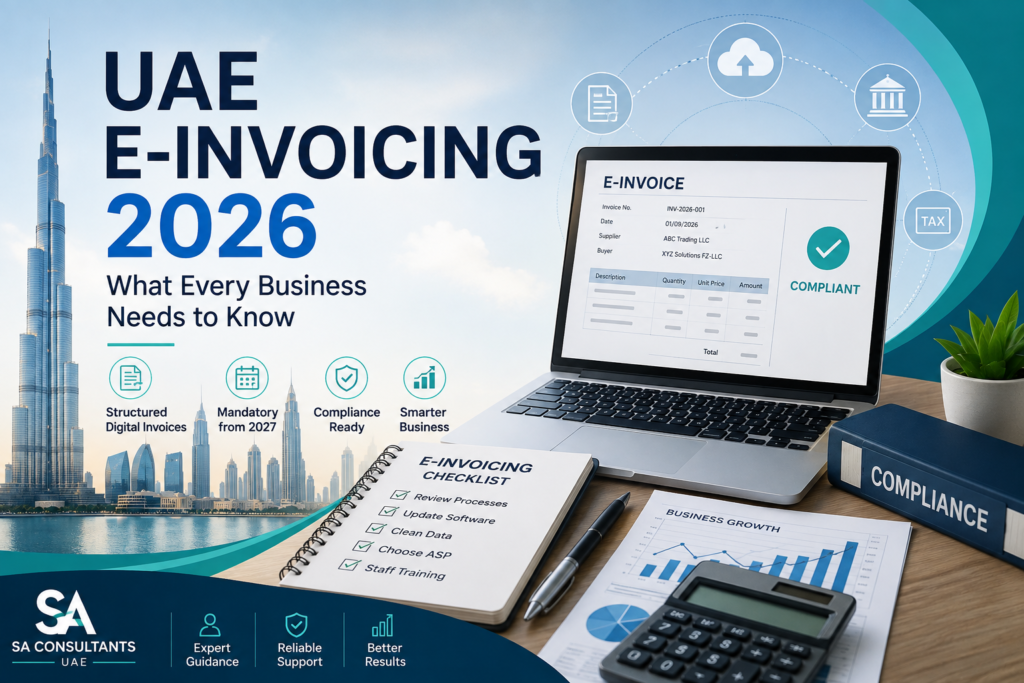
For businesses, the practical question is no longer just “When does e-invoicing start?”
It is:
“Is our accounting and invoicing process ready for it?”
What Is UAE E-Invoicing?
UAE e-invoicing is part of the country’s wider move toward digital business and tax processes.
Instead of creating an invoice and simply sending a PDF to a customer, the e-invoicing framework uses structured electronic invoice data that can be exchanged through the required digital infrastructure.
The objective is to make invoice information more consistent, easier to process, and more efficiently reported through the UAE’s tax ecosystem.
What makes an e-Invoice different?
A normal digital invoice might be a PDF generated by accounting software.
An e-Invoice is different because it contains structured data that can be electronically exchanged and processed within the UAE e-invoicing framework.
The FTA specifically states that PDFs, Word documents, images, scanned copies and emails are not considered e-Invoices.
In simple terms
Think of it this way:
PDF invoice: A document that a person can read.
e-Invoice: Structured invoice data designed to be electronically exchanged and processed.
That distinction is important for businesses preparing their systems.
Why Is the UAE Introducing E-Invoicing?
The UAE is increasingly digitizing financial and tax processes.
According to the Federal Tax Authority, the e-invoicing programme is intended to support digitalization, improve efficiency, reduce manual intervention, strengthen security, and help minimize VAT leakage.
For businesses, the benefits can extend beyond tax reporting.
A properly implemented system can potentially reduce repetitive data entry, improve invoice processing, make reconciliation easier, and provide better visibility over transactions.
The real benefit, however, depends on how well a company prepares.
Poor financial data going into a digital system can still produce poor results.
UAE E-Invoicing Requirements: What Businesses Should Understand
The UAE e-invoicing requirements apply through a phased implementation framework.
The UAE Ministry of Finance has stated that mandatory implementation will begin from January 2027 for businesses falling within the relevant phase.
Businesses should therefore look at e-invoicing as a preparation project rather than something to deal with at the last minute.
Who Is Affected by UAE E-Invoicing?
The UAE framework covers business transactions within the defined scope, including B2B and B2G transactions, subject to applicable exclusions and requirements.
The Ministry of Finance’s framework also provides for voluntary participation during the earlier stages of the programme.
Businesses should determine their own implementation requirements based on their revenue, activities, transaction types, and the applicable regulations.
Businesses should review
- Annual revenue
- B2B transactions
- B2G transactions
- Current invoicing processes
- Accounting software
- ERP systems
- Customer records
- Supplier records
- VAT information
- Financial reporting processes
This is where professional accounting support can be useful.
UAE E-Invoicing Timeline
One of the most important things businesses need to understand is that the implementation is phased.
For businesses with annual revenue of AED 50 million or more, the Ministry of Finance extended the deadline for appointing an Accredited Service Provider to 30 October 2026, while the mandatory implementation date remains 1 January 2027.
For businesses with annual revenue below AED 50 million, the published framework provides for an Accredited Service Provider appointment deadline of 31 March 2027 and mandatory implementation by 1 July 2027. Government entities have a separate timeline, with implementation scheduled for 1 October 2027.
Quick timeline
| Business category | ASP deadline | Mandatory implementation |
|---|---|---|
| Revenue AED 50M or more | 30 October 2026 | 1 January 2027 |
| Revenue below AED 50M | 31 March 2027 | 1 July 2027 |
| Government entities | 31 March 2027 | 1 October 2027 |
Important: Businesses should always verify the latest requirements directly through the UAE Ministry of Finance and Federal Tax Authority because implementation details can be updated.
What Is an Accredited Service Provider?
An Accredited Service Provider (ASP) is a service provider approved under the UAE’s e-invoicing framework to provide electronic invoicing services.
The Ministry of Finance maintains an official list of accredited providers and periodically updates it.
Businesses should not select a provider simply because it offers generic electronic invoicing software.
The solution needs to work within the UAE’s specific e-invoicing framework.
What Should You Ask an E-Invoicing Provider?
Before selecting an ASP, businesses should consider:
Does the solution support UAE requirements?
The provider should be able to explain how its system works with the UAE framework.
Can it integrate with your accounting system?
Integration can be particularly important for businesses already using accounting or ERP software.
Can it handle your transaction volume?
A solution suitable for a small business may not be appropriate for a larger organization with thousands of monthly transactions.
How will customer and supplier information be handled?
Accurate master data is essential for smooth invoicing.
What support is provided during implementation?
Businesses should understand the onboarding, testing, integration and ongoing support process.
The Ministry of Finance provides an official list of e-invoicing Accredited Service Providers that businesses can consult.
Does a PDF Invoice Count as an E-Invoice in the UAE?
No.
A PDF invoice alone does not qualify as a UAE e-Invoice.
The Federal Tax Authority explains that an e-Invoice must be structured invoice data that is electronically issued, exchanged and reported through the applicable system. PDFs, Word documents, images, scanned invoices and emails are specifically identified as unstructured formats rather than e-Invoices.
This is one of the easiest points for business owners to misunderstand.
Example
Imagine a Dubai company creates an invoice using Word, saves it as a PDF, and emails it to its customer.
That is a digital invoice document.
It is not automatically a UAE e-Invoice.
The important difference is the structured electronic format and the required exchange and reporting process.
How Will E-Invoicing Affect Accounting?
This is where e-invoicing becomes more than an invoicing issue.
Your accounting system, bookkeeping process, customer database and tax records need to work together.
If your accounting records are already well organized, the transition may be easier.
If your business has months of unreconciled transactions, duplicate customer records, inconsistent VAT information, or incomplete supplier data, implementation can become more complicated.
Your Accounting Software Matters
Businesses should review whether their current accounting software or ERP system can support the required e-invoicing process.
Before implementation
Review:
- Invoice numbering
- Customer master data
- Supplier information
- VAT registration details
- Tax treatment
- Product and service descriptions
- Chart of accounts
- Credit note processes
- Sales records
- Purchase records
- Bank reconciliation
Why clean data matters
Digital systems can automate processes, but they cannot automatically fix every underlying accounting problem.
If incorrect information is entered into the system, automation can simply make the incorrect process faster.
That is why bookkeeping cleanup and data review should be considered part of e-invoicing preparation.
UAE E-Invoicing and Small Businesses
Small and medium-sized businesses may assume that e-invoicing is something only large corporations need to worry about.
That is not a safe assumption.
The UAE’s implementation framework includes businesses below AED 50 million in a later phase, with mandatory implementation scheduled for 1 July 2027 under the current timeline.
For a small business, this may actually provide a useful advantage:
There is time to prepare.
Instead of waiting until the deadline approaches, a business can gradually review its accounting systems, invoice processes, customer records and bookkeeping.
What Should an SME Do First?
Start with the basics.
Step 1: Review your current invoicing process
Document how an invoice is created from beginning to end.
Step 2: Review your accounting software
Ask your software provider about UAE e-invoicing compatibility and integration.
Step 3: Clean your financial data
Correct duplicate records, missing information and reconciliation issues.
Step 4: Review customer and supplier records
Make sure important business information is accurate and complete.
Step 5: Understand your implementation deadline
Determine which phase applies to your business.
Step 6: Plan the transition
Do not leave software integration and staff training until the final weeks.
Is UAE E-Invoicing Only About Tax Compliance?
Not necessarily.
Compliance is an important part of the programme, but businesses can also use the transition as an opportunity to improve their financial processes.
A better-connected invoicing system can support:
- Faster invoice processing
- Better record keeping
- Reduced manual data entry
- Improved financial visibility
- Easier reconciliation
- Better accounts receivable management
- More consistent reporting
The UAE Ministry of Finance has described e-invoicing as part of the country’s digital transformation and a move toward a more integrated financial ecosystem.
For business owners, that means the transition can be viewed as both a compliance requirement and a chance to modernize financial operations.
Common UAE E-Invoicing Mistakes to Avoid
Businesses do not necessarily need a complicated strategy.
They need to avoid preventable mistakes.
Waiting Until the Deadline
Implementation can involve software, data, processes and staff.
Starting early gives businesses more time to test and correct issues.
Assuming a PDF Is Enough
This is one of the biggest misconceptions.
A PDF is not automatically an e-Invoice under the UAE framework.
Ignoring Accounting Data
E-invoicing is connected to accounting information.
Incomplete or inconsistent records can create unnecessary implementation problems.
Choosing Software Without Checking UAE Compatibility
A generic invoicing application may not meet the specific UAE framework requirements.
Forgetting Credit Notes
Businesses should also understand how electronic credit notes fit into their invoicing processes. The Ministry of Finance’s framework includes electronic credit notes for situations such as cancellations, reductions, refunds and certain errors.
Treating E-Invoicing as an IT Project Only
IT is important, but accounting and finance teams need to be involved.
The transition can affect:
- Finance
- Accounting
- Sales
- Procurement
- IT
- Management
How Dubai Businesses Can Prepare for E-Invoicing
For businesses in Dubai, preparation can start with a simple internal review.
H3: Review Your Current Invoices
Look at the information currently included on your invoices.
H3: Review Your Accounting Process
Check how sales, purchases, VAT and customer payments are recorded.
H3: Review Your Software
Talk to your accounting or ERP provider about compatibility and integration.
H3: Review Your Bookkeeping
Make sure transactions are being recorded and reconciled consistently.
H3: Review Your Internal Responsibilities
Decide who will manage implementation, testing, approvals and ongoing monitoring.
H4: Don’t Forget Staff Training
Even a good system can fail if employees do not understand the new process.
H5: Document the New Workflow
Create a simple internal procedure showing who creates, reviews, approves and monitors invoices.
UAE E-Invoicing and Bookkeeping: Why They Go Together
A business may think of bookkeeping and invoicing as separate activities.
In practice, they are closely connected.
Sales invoices affect revenue records.
Purchase invoices affect expenses and potentially VAT records.
Credit notes affect accounting balances.
Customer payments affect receivables and cash flow.
That means a strong bookkeeping process can make the transition to electronic invoicing much easier to manage.
For businesses that have fallen behind on bookkeeping, an e-invoicing project can actually be a good opportunity to bring financial records up to date.
What Should a Business Do in September 2026?
For businesses preparing now, the next few months should be used for practical preparation rather than panic.
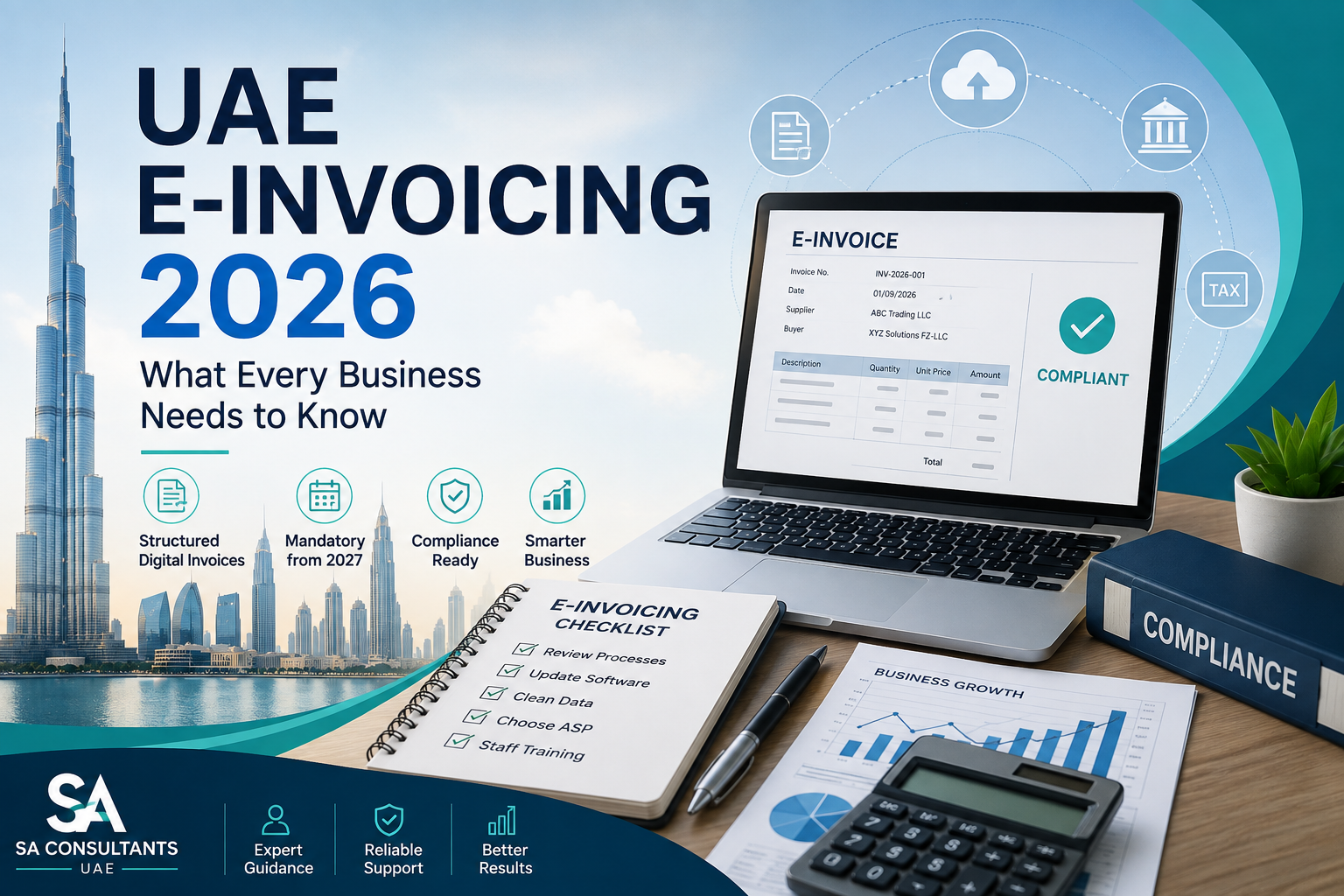
A useful checklist is:
September
- Identify the applicable e-invoicing phase
- Review current invoicing processes
- Review accounting software
- Check customer and supplier data
- Identify bookkeeping gaps
October–November
- Evaluate suitable Accredited Service Providers
- Discuss integration requirements
- Begin system preparation
- Review invoice and accounting workflows
December and Beyond
- Test systems
- Train staff
- Review data
- Correct implementation issues
- Establish ongoing monitoring
For businesses approaching the 1 January 2027 implementation date, the remaining preparation window should be treated seriously. The Ministry of Finance has kept that mandatory implementation date unchanged for businesses with annual revenue above AED 50 million.
Frequently Asked Questions About UAE E-Invoicing 2026
What is UAE e-invoicing?
UAE e-invoicing is a structured electronic invoicing system in which invoice data is issued and exchanged electronically and reported through the UAE’s tax framework.
Is a PDF invoice considered an e-Invoice in the UAE?
No. The Federal Tax Authority states that PDFs, Word documents, images, scanned copies and emails are not considered e-Invoices.
When does mandatory e-invoicing start in the UAE?
Mandatory implementation is phased. Businesses with annual revenue of AED 50 million or more are scheduled for mandatory implementation by 1 January 2027, while businesses below AED 50 million are scheduled for 1 July 2027 under the current framework.
When must large UAE businesses appoint an Accredited Service Provider?
The Ministry of Finance extended the ASP appointment deadline for businesses with annual revenue above AED 50 million to 30 October 2026.
What is an Accredited Service Provider?
An Accredited Service Provider is a service provider approved under the UAE e-invoicing framework to provide electronic invoicing services. The Ministry of Finance publishes an official list of accredited providers.
Do small businesses in Dubai need to prepare for e-invoicing?
Yes. Businesses below AED 50 million fall into a later implementation phase under the current framework, with mandatory implementation scheduled for 1 July 2027.
Does e-invoicing replace accounting software?
No. E-invoicing works alongside a business’s accounting or ERP environment. Businesses should assess how their existing systems can integrate with the required e-invoicing process.
Does e-invoicing affect bookkeeping?
It can. Invoice data is closely connected to sales, purchases, VAT records, receivables, payables and financial reporting. Clean bookkeeping can make implementation easier.
Should a UAE business start preparing now?
Yes. Businesses can use the available preparation period to review their accounting systems, financial data, invoicing processes and service-provider options before their applicable deadline.
Final Thoughts: E-Invoicing Is a Business Change, Not Just an Invoice Change
The UAE’s move toward electronic invoicing is part of a much larger shift toward digital financial and tax processes.
For business owners, the easiest approach is not to wait until the deadline and then try to change everything at once.
Start with the fundamentals:
Understand your deadline.
Review your accounting software.
Clean your financial records.
Check your customer and supplier data.
Understand the Accredited Service Provider process.
Train the people who will use the system.
Most importantly, treat e-invoicing as an opportunity to improve the way your business manages financial information.
If your bookkeeping is accurate and your financial processes are organized, moving to a more digital invoicing environment can be considerably easier.
SA Consultants UAE can help businesses review their bookkeeping and accounting processes, identify areas that need attention, and prepare their financial operations for changing UAE compliance requirements.
For a Dubai or UAE business that is unsure where to begin, the first step is simple: review your current invoicing and accounting process before the deadline arrives.