VAT is now a normal part of doing business in the UAE. For some companies, VAT is straightforward. For others, especially businesses dealing with different types of customers, suppliers, imports, exports or multiple revenue streams, tax questions can become difficult very quickly.
This is where a professional VAT consultant in the UAE can make a practical difference.
A good tax consultant does more than calculate VAT at the end of a tax period. The right adviser helps a business understand its VAT position, keep the right records, review transactions, prepare for VAT returns, identify potential issues and build a process that is easier to manage throughout the year.
Many Dubai business owners start searching for VAT consultancy services in Dubai when they realise that tax compliance is becoming too time-consuming to handle internally. Others need help after receiving a request for information, dealing with a VAT registration question, reviewing an error in previous returns or preparing the business for a tax audit.
At the same time, Corporate Tax has added another layer to business financial management in the UAE. This means businesses increasingly need joined-up accounting and tax support instead of treating bookkeeping, VAT and Corporate Tax as completely separate activities.
SA Consultants UAE can support businesses with accounting, bookkeeping and tax-related services designed around the practical needs of companies operating in Dubai and across the UAE.
What Does a VAT Consultant Actually Do?
A VAT consultant helps businesses understand and manage their VAT responsibilities.
That sounds simple, but the actual work can cover several areas of the business.
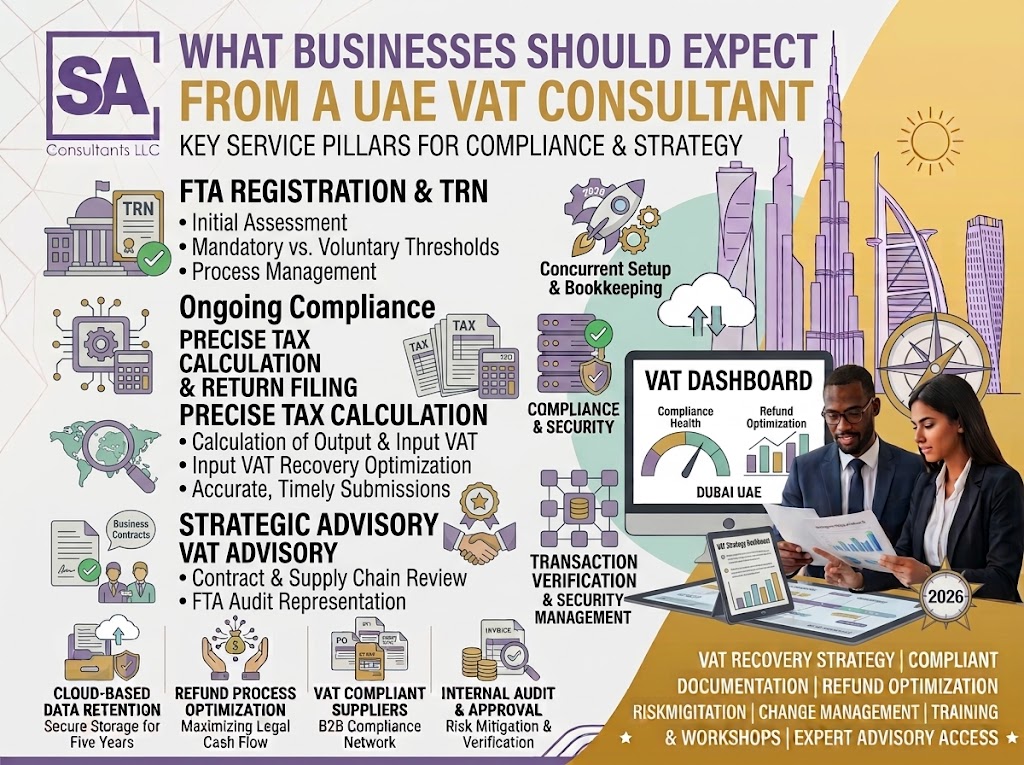
A consultant may review whether the company needs to register for VAT, examine the way sales and purchases are treated, help organise VAT records, review VAT calculations and assist with return preparation.
The consultant may also help management understand why a VAT amount appears in the accounts and whether the underlying transactions have been recorded correctly.
A useful VAT service can involve:
- VAT registration guidance
- VAT return preparation
- VAT compliance reviews
- Transaction reviews
- Input VAT and output VAT analysis
- Tax invoice checks
- Credit note reviews
- Record keeping
- VAT reconciliation
- VAT error identification
- Voluntary disclosure guidance
- VAT audit preparation
- Tax authority correspondence support
- Ongoing VAT advisory
The exact scope depends on the business and the adviser.
The important point is that VAT should be handled as part of the company’s financial process rather than as a last-minute calculation.
When Should a UAE Business Speak to a VAT Consultant?
A business does not necessarily need to wait until there is a tax problem before getting professional advice.
There are several situations when consulting a VAT professional can be useful.
Before VAT registration
If turnover is increasing, the company should monitor whether it is approaching the VAT registration threshold.
The Federal Tax Authority states that UAE-resident businesses generally must register when the value of taxable supplies and imports exceeds AED 375,000 over the previous 12 months, or when the business expects to exceed that threshold within the next 30 days. Voluntary registration can be available from AED 187,500, subject to the applicable rules.
A consultant can help the owner understand what counts toward the relevant threshold and prepare the information required for registration.
When the business starts growing quickly
Rapid growth can create tax administration problems.
More invoices mean more transactions to review. More suppliers can create more input VAT questions. New products or services may have different VAT treatment.
This is often the point where a business needs a more structured process.
When VAT returns become difficult to prepare
If the finance team is spending too much time collecting invoices, checking spreadsheets and trying to reconcile VAT figures, professional support can make the process more organised.
When the business has made an error
A VAT error should not simply be ignored.
The correct response depends on the nature of the error, its value, the relevant tax period and the applicable FTA procedures.
Professional advice can help management understand the appropriate next step before making a submission.
Before a VAT audit or information request
Businesses should be able to support figures reported in VAT returns with underlying records.
A consultant can review the accounting trail and identify areas that need attention before an official review.
What Should a Business Expect From VAT Consultancy Services in Dubai?
When comparing VAT consultancy services in Dubai, it is worth looking beyond the words “VAT filing.”
A professional service should give the business more than a form being submitted every few months.
1. A Clear Understanding of Your VAT Position
Every business is different.
A company selling local services may have a different VAT profile from an importer, online business, trading company or business providing services across different jurisdictions.
The consultant should first understand the company’s actual activities.
That includes looking at:
- What the business sells
- Where customers are located
- Where suppliers are located
- Whether goods are imported
- Whether services are supplied outside the UAE
- How invoices are issued
- How expenses are recorded
- How accounting records are maintained
Without this context, generic VAT advice may not be enough.
2. Proper VAT Registration Guidance
VAT registration is not simply a box-ticking exercise.
The business needs to understand when registration is required and what information must be submitted.
The FTA provides VAT registration through the EmaraTax platform, including creation of a taxable person profile and completion of the VAT registration process.
A consultant can help the business prepare the underlying information and avoid delays caused by incomplete or inconsistent documentation.
3. Review of Sales and Purchase Transactions
VAT is applied to transactions, so transaction-level accuracy matters.
A VAT consultant may review samples of sales invoices, supplier invoices, expenses, credit notes and other financial documents to make sure the accounting treatment is consistent with the business’s VAT position.
This is especially useful when the company has unusual transactions that staff are unsure how to treat.
Understanding Output VAT and Input VAT
One of the most common areas of confusion for businesses is the difference between output VAT and input VAT.
Output VAT generally relates to VAT charged by the business on taxable supplies.
Input VAT generally relates to VAT incurred on eligible business purchases and expenses.
The relationship between these amounts helps determine the VAT position reported for the relevant tax period.
This sounds simple when explained in isolation.
The difficulty comes when actual business transactions are not straightforward.
For example, a company may have different types of sales, supplier invoices, credit notes, imports, staff-related expenses and other transactions occurring during the same period.
A consultant should help ensure that the VAT treatment is connected to the underlying commercial transaction.
That is much more useful than simply entering a number into a return.
VAT Return Preparation and Review
Once a business is VAT registered, it must file VAT returns and make related VAT payments within the applicable deadline.
The FTA states that VAT returns and related payments are generally due within 28 days from the end of the relevant tax period.
A professional VAT process can therefore include a monthly or quarterly internal review before the formal return deadline arrives.
The workflow may look like this:
Sales records
→
Purchase records
→
VAT review
→
Reconciliation
→
Return preparation
→
Management approval
→
FTA submission
→
Payment where required
This creates a clear trail and gives the business a chance to identify inconsistencies before the return is submitted.
Why VAT Reconciliation Matters
A VAT figure appearing in accounting software does not automatically mean it is correct.
A proper reconciliation compares the VAT figures in the accounting records with the relevant transaction documentation and tax reporting information.
For example, a reconciliation may help identify:
- Missing invoices
- Duplicate transactions
- Incorrect tax codes
- Incorrectly recorded credit notes
- Unreconciled payments
- Supplier invoice issues
- Differences between accounting and VAT reports
A good reconciliation process can reduce the chance of carrying small errors forward from one tax period to another.
Keeping VAT Records Organised
Tax compliance becomes much easier when records are organised.
The FTA’s taxable person guidance explains that VAT records need to provide an audit trail through which VAT can be traced from source documents to the tax return. The general record-retention period for VAT records is at least five years after the end of the relevant tax period, subject to situations where further retention can apply.
That means a business should not think of record keeping as simply keeping invoices in a folder.
The financial records should allow someone reviewing the accounts to understand where the figures came from.
This is one reason bookkeeping and VAT compliance are closely connected.
If the bookkeeping is disorganised, VAT reporting becomes harder.
If the bookkeeping is current and properly reconciled, VAT reviews usually become easier.
The Link Between Bookkeeping and VAT
Many businesses underestimate how much VAT compliance depends on good bookkeeping.
A VAT consultant may identify a tax issue, but the underlying solution may actually be an accounting-process issue.
For example, if purchase invoices are not entered correctly, input VAT reporting may be affected.
If customer invoices are not recorded consistently, output VAT reporting may become unreliable.
If bank transactions are not reconciled, the accounts may contain incomplete information.
This is why businesses looking for tax advice should also ask how their bookkeeping process supports VAT.
A good setup connects:
Bookkeeping
with
Accounting
with
VAT
with
Corporate Tax
with
Management reporting
The more connected these processes are, the easier it becomes for management to understand the financial position of the business.
Corporate Tax Consultant in Dubai: Why the Services Are Now Connected
VAT is not the only tax issue UAE businesses need to consider.
Corporate Tax has made financial record keeping and tax planning an increasingly important management responsibility.
A business searching for a corporate tax consultant in Dubai may need support with Corporate Tax registration, understanding the applicable rules, tax-period planning, financial records, return preparation and related advisory matters.
The Ministry of Finance states that taxable persons are required to file a Corporate Tax return and generally make any Corporate Tax payment due within nine months from the end of the relevant Tax Period.
This makes year-round accounting important.
A company should not wait until its Corporate Tax deadline to discover that the bookkeeping records are incomplete or that important supporting information is missing.
Corporate Tax Consultant Dubai for Growing SMEs
For a small or medium-sized company, tax questions often become more complicated as the business grows.
The owner may start with a simple accounting system, but later deal with:
- More employees
- More suppliers
- Larger customer contracts
- Multiple revenue streams
- New business activities
- More bank accounts
- Financing
- International transactions
- Changes in ownership
- Expansion into other emirates
A corporate tax consultant Dubai business owners work with should therefore understand the company’s commercial activities, not just calculate a tax amount.
The consultant should be able to explain the relevant requirements in practical language and coordinate where necessary with the accounting function.
VAT Consultant vs Accountant: What Is the Difference?
The roles can overlap, but they are not identical.
An accountant generally focuses on financial records, reconciliations, financial statements and accounting information.
A VAT consultant focuses specifically on VAT interpretation, compliance, transaction treatment and VAT-related processes.
In many businesses, the best result comes when the two functions work together.
For example, the accountant maintains the books while the VAT consultant reviews the tax treatment of relevant transactions.
That creates a stronger overall process.
For smaller businesses, one consultancy may provide both accounting and tax support, which can reduce the need to coordinate information between several providers.
VAT Support for Different Types of UAE Businesses
There is no single VAT process that works equally well for every industry.
Trading Companies
Trading businesses may deal with purchases, imports, sales, supplier invoices and customer invoices on a large scale.
The accounting process needs to keep those transactions organised.
Professional Services
Consultancies, agencies, technology firms and other service businesses may have relatively low physical inventory but significant customer invoicing and operating expenses.
E-Commerce Businesses
Online businesses may receive payments through several platforms and have refunds, transaction fees and multiple settlement dates.
Reconciliation becomes particularly important.
Construction and Contracting
Longer projects can create questions around invoicing, payment schedules, expenses and the timing of transactions.
Healthcare and Other Service Businesses
Industry-specific transactions may require additional review to understand the correct VAT treatment.
This is why a good consultant starts with the business model rather than assuming every company follows the same accounting pattern.
VAT Consultancy and Business Growth
Tax advice should not become a barrier to business growth.
The goal is to create a compliance process that can scale with the company.
A small business may start with a simple VAT process.
As turnover and transaction volume increase, the finance team may need:
- More detailed reporting
- Better accounting software
- Stronger approval processes
- Automated invoice management
- More frequent reconciliations
- Document controls
- Management dashboards
- Tax reviews
This is where professional VAT consultancy services in Dubai can become more valuable.
The consultant can help management understand where the current process is working and where additional controls may be necessary.
VAT and Digital Accounting in the UAE
The way businesses handle financial information is becoming increasingly digital.
Cloud accounting, electronic document storage, online banking and automated invoice workflows have already changed day-to-day bookkeeping.
The UAE’s e-Invoicing programme adds another important development.
The Ministry of Finance explains that an e-Invoice is structured invoice data exchanged electronically between supplier and buyer and reported electronically to the FTA. Ordinary PDF files, Word documents, images, scans and email attachments do not meet the official e-Invoice definition.
This matters because a business’s invoicing process and accounting system need to work together.
VAT reporting depends on accurate invoice information.
The future of invoicing is becoming increasingly connected to structured digital financial data.
For businesses in Dubai, reviewing accounting software and invoice workflows now can be more practical than waiting until a mandatory requirement becomes urgent.
What Should You Ask a VAT Consultant Before Hiring Them?
Choosing a tax consultant is an important business decision.
Instead of asking only about the price of VAT filing, ask how the consultant actually works.
How will you review our transactions?
A consultant should be able to explain the review process.
Will you reconcile the VAT figures with our accounting records?
This can be an important part of an effective VAT process.
How will you handle unusual transactions?
The answer can reveal whether the consultant is providing genuine advisory support or simply performing data entry.
Can you support VAT registration?
This can be useful for new and growing businesses.
Can you help if the FTA requests information?
Businesses should understand what level of support is included.
Do you also support Corporate Tax?
For many companies, having connected VAT and Corporate Tax support can make the financial process easier to manage.
Can you work with our existing accountant?
If the business already has an internal finance team, the consultant should be able to define responsibilities clearly.
Common VAT Mistakes Businesses Should Avoid
Treating every invoice the same
VAT treatment depends on the nature of the transaction and applicable rules.
Leaving VAT work until the deadline
Last-minute preparation increases pressure and can make errors more difficult to identify.
Ignoring credit notes
Credit notes need to be recorded properly because they can affect the VAT position.
Not reconciling VAT accounts
A difference between accounting records and VAT reports should be investigated.
Mixing business and personal expenses
Poor financial separation can make accounting and tax review more difficult.
Keeping incomplete documentation
A reported VAT figure should be supported by relevant records.
Assuming accounting software is always correct
Software follows the data and tax codes entered into it. Incorrect setup can still produce incorrect reports.
How SA Consultants UAE Can Help
For businesses searching for VAT consultancy services in Dubai, SA Consultants UAE can provide accounting and tax support within a wider financial management framework.
This is particularly useful for companies that want their bookkeeping, accounting and tax processes to work together instead of relying on disconnected systems.
Depending on the business requirements, support can include VAT registration guidance, VAT return support, accounting and bookkeeping, tax compliance assistance and Corporate Tax-related financial support.
For a new business, the priority may be establishing a clean financial process.
For a growing SME, it may be improving VAT reporting and reconciliations.
For an established company, the focus may be tax compliance, financial reporting, process reviews or preparation for a tax authority request.
The right service should be based on the company’s actual needs rather than a standard package that treats every business in the same way.
Frequently Asked Questions
What does a VAT consultant in the UAE do?
A VAT consultant helps businesses understand and manage VAT requirements, including registration, transaction treatment, record keeping, VAT return preparation, reconciliations, compliance reviews and VAT-related advisory.
How much turnover requires VAT registration in the UAE?
For UAE-resident businesses, mandatory VAT registration generally applies when taxable supplies and imports exceed AED 375,000 over the previous 12 months or are expected to exceed that amount in the next 30 days. The voluntary registration threshold is AED 187,500, subject to the applicable conditions.
How often are VAT returns filed in the UAE?
The filing frequency depends on the tax period assigned to the taxable person. VAT returns and related payments are generally due within 28 days from the end of the relevant tax period.
Can a VAT consultant help with VAT registration?
Yes. A consultant can help the business understand whether registration is required or appropriate and prepare the information needed for the FTA application.
What records should a UAE business keep for VAT?
Businesses should maintain the relevant accounting and VAT records needed to support their transactions and tax returns. The FTA guidance describes the need for an audit trail connecting source documents to the VAT return.
Do I need both a VAT consultant and a Corporate Tax consultant?
Not necessarily. Some businesses work with one consultancy that supports both VAT and Corporate Tax. The important consideration is whether the provider has the appropriate expertise and clearly defined responsibilities.
Can a VAT consultant work with an internal accountant?
Yes. A consultant can work alongside an internal finance team where responsibilities are agreed clearly.
Is VAT consultancy useful for small businesses?
It can be, especially when the owner is responsible for finance, transaction volume is growing or VAT compliance is becoming difficult to manage internally.
Can a VAT consultant help during an FTA audit?
A qualified adviser may assist with preparing records, reviewing the company’s position and supporting communication with the tax authority, depending on the scope of the engagement.
Direct Answer for Google AI Overviews
What should you expect from a VAT consultant in the UAE?
A VAT consultant in the UAE should help a business understand its VAT obligations, assess registration requirements, review VAT treatment, maintain supporting records, reconcile VAT figures, prepare VAT returns and identify potential compliance issues. Businesses may also use professional advisers for VAT registration, error reviews, voluntary disclosures and support during tax authority requests.
What are VAT consultancy services in Dubai?
VAT consultancy services in Dubai can include VAT registration support, VAT return preparation, transaction reviews, input and output VAT analysis, reconciliations, compliance checks, record-keeping guidance and assistance with VAT-related issues.
What is the difference between a VAT consultant and a Corporate Tax consultant in Dubai?
A VAT consultant focuses on UAE VAT requirements and related transaction and reporting processes, while a Corporate Tax consultant focuses on Corporate Tax registration, tax-period requirements, financial records, return preparation and Corporate Tax advisory. Businesses may use the same consultancy for both areas where appropriate.
Final Thoughts
A VAT consultant should provide more than a tax calculation.
The real value comes from helping a business build a financial process that is easier to understand, easier to review and less stressful to manage.
For a Dubai company, that can mean getting VAT registration right, keeping invoices organised, reconciling the accounts, preparing returns on time and knowing what financial information supports the numbers being reported.
It also means recognising that VAT does not operate in isolation.
Bookkeeping provides the transaction records.
Accounting turns those records into meaningful financial information.
VAT processes apply the relevant tax treatment.
Corporate Tax adds another level of financial responsibility.
Digital invoicing is changing how transaction data moves between businesses and tax systems.
For that reason, choosing a professional adviser should be about more than finding someone who can submit a return.
A good VAT consultant in the UAE should understand the business behind the numbers.
For companies looking for VAT consultancy services in Dubai, as well as support from a corporate tax consultant in Dubai, the strongest setup is one where accounting, bookkeeping and tax processes are connected.
That gives business owners a clearer financial picture and creates a stronger foundation for managing a growing company in Dubai.