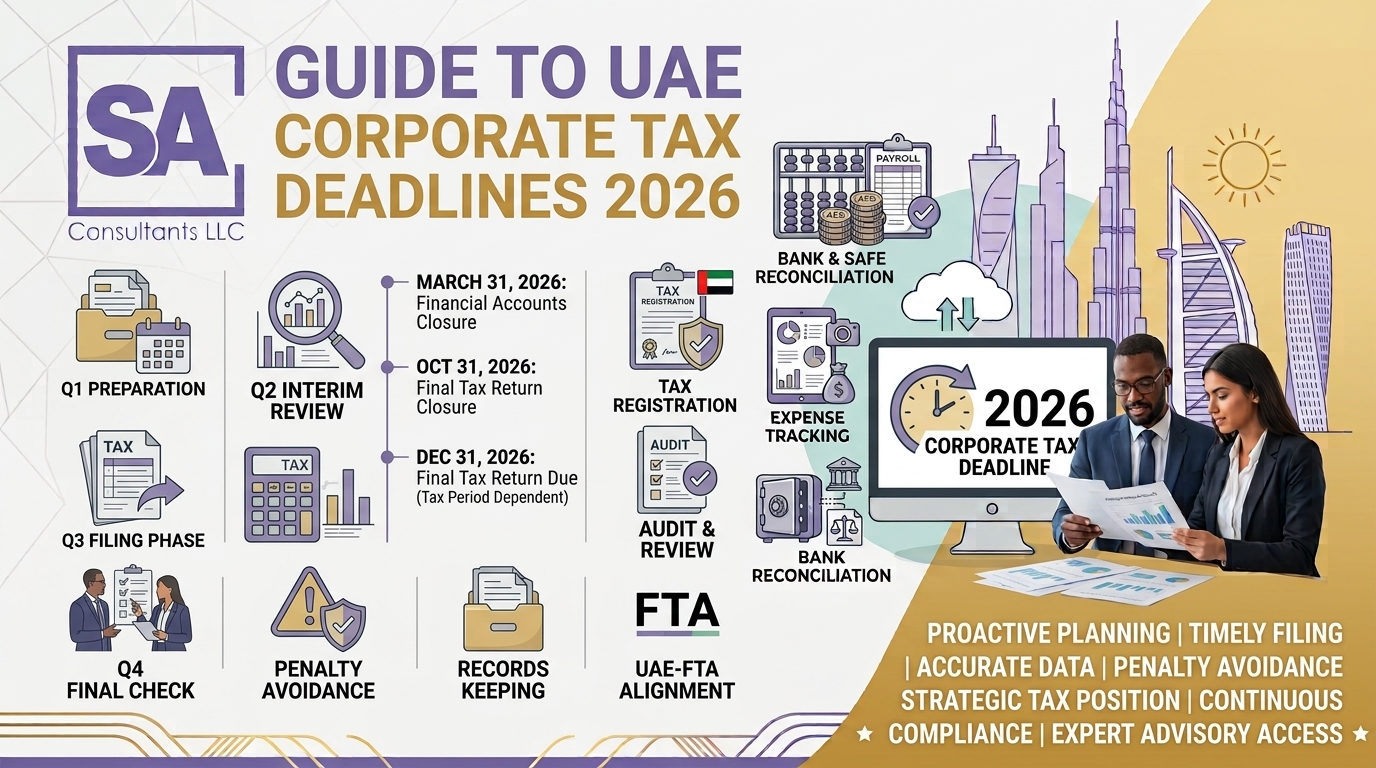
For many UAE businesses, September is an important month for UAE Corporate Tax Deadline 2026.
The Federal Tax Authority has reminded taxable persons whose financial year ended on 31 December 2025 that they must file their Corporate Tax Returns and pay any Corporate Tax due no later than 30 September 2026. The FTA has also stated that businesses eligible for Small Business Relief are required to file their simplified tax returns within the applicable statutory timeframe.
With the deadline approaching, businesses should not leave their accounting and bookkeeping review until the final few days.
The quality of your Corporate Tax filing depends heavily on the quality of the financial records behind it.
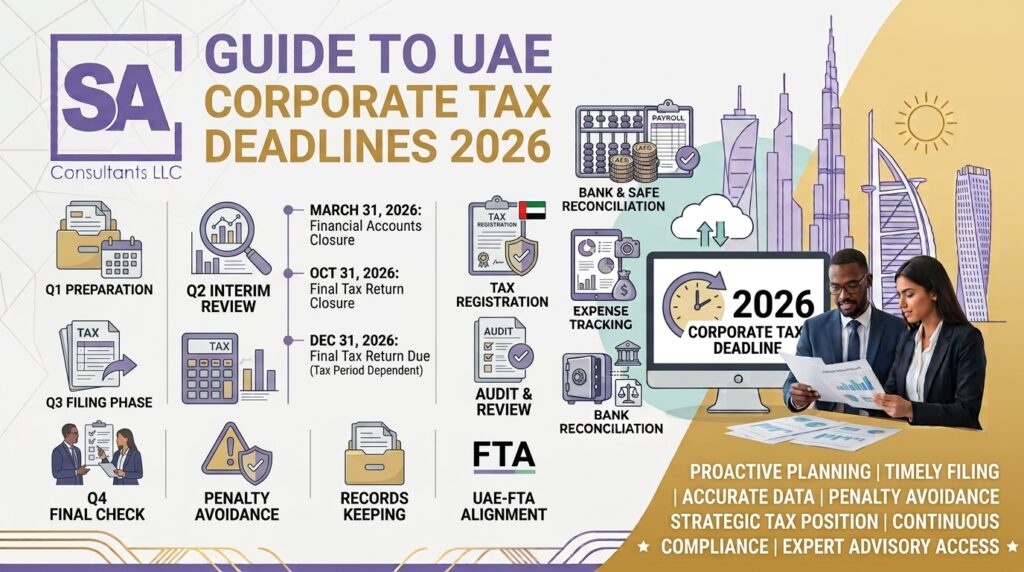
What Is the UAE Corporate Tax Deadline in September 2026?
For taxable persons whose Tax Period ended on 31 December 2025, the deadline to file the Corporate Tax Return and pay the Corporate Tax due is 30 September 2026.
The FTA states that Corporate Tax returns and payments are generally required within a period not exceeding nine months from the end of the relevant Tax Period. Filing and payment are available through the EmaraTax platform.
This means businesses should now be checking whether their accounting records are complete rather than waiting for the deadline.
Why Bookkeeping Matters for Corporate Tax
Corporate Tax preparation starts with reliable accounting records.
If sales, expenses, bank transactions, assets and liabilities have not been recorded correctly, the tax calculation may also require additional review.
A business should be able to answer basic questions such as:
- How much revenue did the business generate?
- Which expenses were recorded?
- Are all business expenses supported by documents?
- Are bank accounts reconciled?
- Are customer and supplier balances correct?
- Are assets properly recorded?
- Are there unusual or one-off transactions?
- Is the accounting period complete?
- Are the financial statements consistent with the underlying records?
This is where bookkeeping for Corporate Tax in the UAE becomes important.
Good bookkeeping does not replace tax advice, but it creates the financial foundation required for accurate reporting.
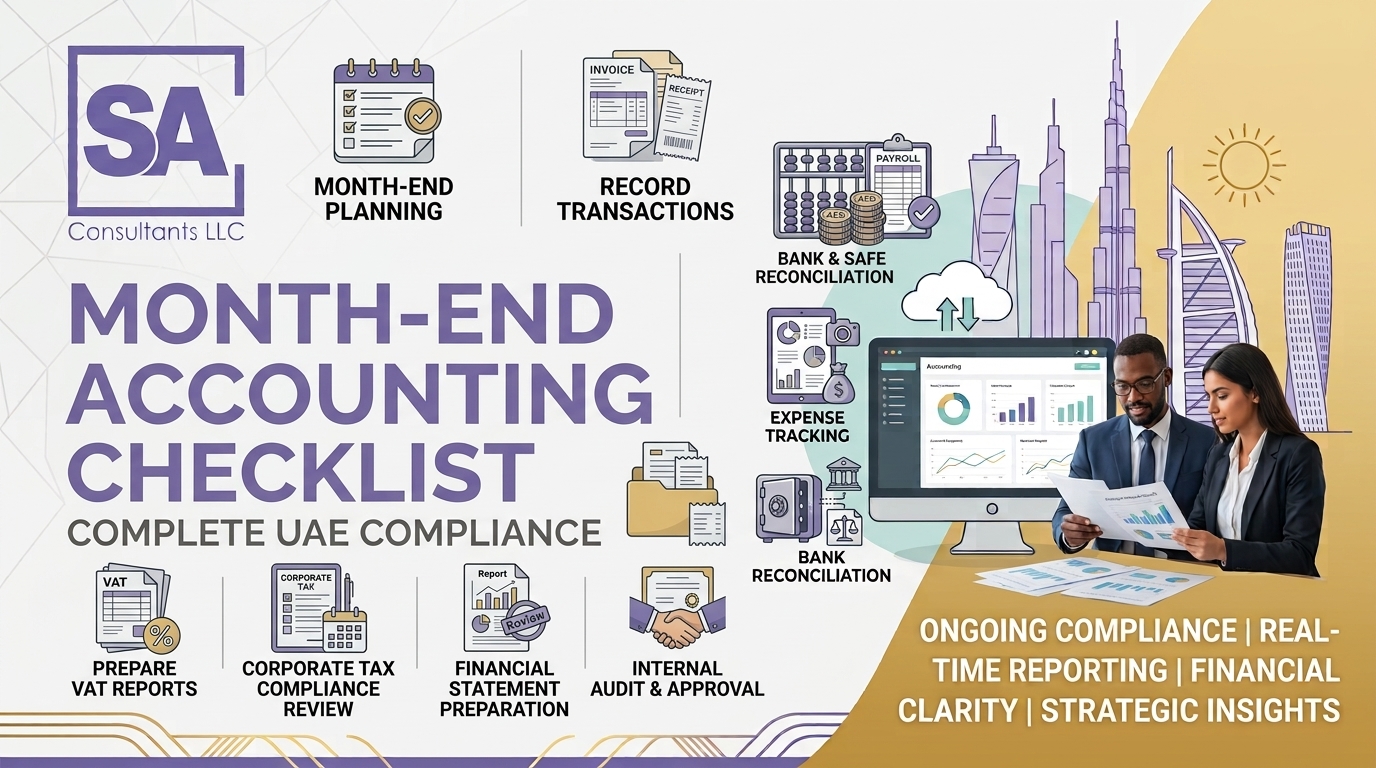
Corporate Tax Accounting Checklist for UAE Businesses
Before filing, businesses should review the following areas.
1. Reconcile All Bank Accounts
Start with the bank statements.
Every business bank account should be reconciled with the accounting system for the relevant Tax Period.
Look for:
- Missing bank transactions
- Duplicate entries
- Unrecorded bank charges
- Unidentified transfers
- Incorrect payment amounts
- Transactions posted to the wrong account
A bank reconciliation can uncover errors that may otherwise remain hidden in the accounts.
2. Review Sales and Revenue
Check that all business income has been recorded correctly.
Compare accounting records against available sales invoices, payment records and bank receipts.
Pay particular attention to:
- Credit notes
- Refunds
- Cancelled invoices
- Large customer payments
- Unusual revenue transactions
- Revenue recorded in the wrong period
The objective is to make sure the accounting records provide a complete picture of business income.
3. Review Business Expenses
The next step is to review expenses.
Check whether expenses have been:
- Recorded in the correct accounting period
- Categorised correctly
- Supported by appropriate documents
- Related to the business
- Properly reflected in the accounting system
Do not simply assume that every transaction in the bookkeeping system should automatically reduce taxable income.
Corporate Tax treatment can depend on the nature and circumstances of the expense.
4. Check Accounts Receivable
Review outstanding customer balances.
Ask:
- Which invoices remain unpaid?
- Are old balances still recoverable?
- Are there disputed invoices?
- Have credit notes been processed?
- Are customer balances supported by records?
An accurate receivables ledger also helps management understand the difference between accounting profit and actual cash available to the business.
5. Check Accounts Payable
Supplier balances should also be reviewed.
Make sure outstanding supplier invoices are genuine, recorded correctly and supported by appropriate documentation.
This is particularly important where the business has a large number of suppliers or transactions.
6. Review Fixed Assets
Businesses should also check their fixed asset records.
This can include:
- Office equipment
- Vehicles
- Computers
- Machinery
- Furniture
- Other business assets
Check whether purchases, disposals and depreciation-related accounting entries have been recorded consistently.
7. Review Related-Party Transactions
If your business has transactions with related parties or connected persons, these should receive additional attention.
Examples may include:
- Payments to related companies
- Management fees
- Loans
- Shared expenses
- Transactions between group entities
These transactions should be properly documented and reviewed according to the applicable UAE Corporate Tax requirements.
8. Check the Financial Statements
Before finalising the Corporate Tax position, review the financial statements.
At minimum, management should understand:
Profit and Loss
Revenue, cost of sales, operating expenses and profit or loss.
Balance Sheet
Assets, liabilities and equity.
Cash Position
Actual bank balances and other available funds.
Receivables and Payables
Amounts owed by customers and amounts payable to suppliers.
If the numbers do not appear reasonable, investigate the accounting records before proceeding.
What Records Should UAE Businesses Keep?
Maintaining supporting documents is an important part of Corporate Tax compliance.
The FTA has repeatedly emphasised the need for taxable persons to prepare and maintain the documents required to support their tax returns.
A practical accounting file may include:
- Sales invoices
- Purchase invoices
- Bank statements
- Expense receipts
- Contracts
- Payroll records
- Asset records
- Loan documentation
- Customer records
- Supplier records
- Accounting ledgers
- Financial statements
- Relevant tax records
The exact records required depend on the business and its circumstances.
What If Your Bookkeeping Is Not Up to Date?
This is one of the most common problems businesses face close to a tax deadline.
If bookkeeping is several months behind, the first priority should be to establish a reliable accounting position.
A typical cleanup process can involve:
Collect documents → Enter transactions → Reconcile accounts → Review balances → Prepare reports → Review tax position
Trying to calculate Corporate Tax from an incomplete spreadsheet or an unreconciled bank account can create unnecessary problems.
If the accounting records are incomplete, businesses should allow sufficient time for professional review before the filing deadline.
What About Businesses Eligible for Small Business Relief?
The FTA’s September 2026 reminder specifically states that persons eligible for Small Business Relief are still required to file simplified tax returns within the applicable statutory timeframe.
Therefore, businesses should not assume that being eligible for relief means there is nothing to file.
The applicable eligibility conditions and tax treatment should be reviewed based on the business’s circumstances and the relevant UAE Corporate Tax rules.
September 30 Is Not the Time to Start Your Bookkeeping
A Corporate Tax return is only as reliable as the information used to prepare it.
If your bookkeeping has been updated every month, the September filing process should mainly involve reviewing the records, finalising the relevant financial information and preparing the return.
If bookkeeping has been delayed for months, the process becomes much more difficult.
That is why monthly accounting services in the UAE can be valuable even when a business only thinks about tax once or twice a year.
Monthly bookkeeping helps create a financial trail throughout the year instead of forcing the business to reconstruct everything at the last minute.
How Accounting Services Can Help Before the UAE Tax Deadline
Professional accounting support can help businesses with:
- Bookkeeping cleanup
- Bank reconciliation
- Accounts payable and receivable
- Financial statement preparation
- Expense review
- Accounting record organisation
- Corporate Tax accounting support
- Tax documentation preparation
- Ongoing monthly reporting
For Dubai-based businesses, accounting services in Dubai can also provide ongoing support after the September deadline so that the next Corporate Tax period does not become another last-minute exercise.
A Quick UAE Corporate Tax Deadline Checklist
Before 30 September 2026, ask:
Accounting
- Are all transactions recorded?
- Are the bank accounts reconciled?
- Are receivables and payables reviewed?
- Are fixed assets properly recorded?
- Are financial statements ready?
Bookkeeping
- Are sales invoices complete?
- Are supplier invoices recorded?
- Are expenses supported?
- Are unusual transactions reviewed?
- Is the ledger up to date?
Tax
- Is the business registered for Corporate Tax where required?
- Is the relevant Tax Period confirmed?
- Has the tax position been reviewed?
- Is the return ready for filing?
- Is any Corporate Tax payable ready for payment?
Documentation
- Are invoices available?
- Are bank statements available?
- Are contracts and supporting documents organised?
- Can accounting entries be supported if requested?
How SA Consultants UAE Can Support Businesses
SA Consultants UAE provides accounting, bookkeeping and tax-related support for UAE businesses.
For companies approaching a Corporate Tax filing deadline, getting the accounting records organised can be just as important as the final filing itself.
A reliable process should help businesses maintain accurate books, reconcile accounts, prepare financial reports and keep supporting documentation organised throughout the year.
Instead of treating Corporate Tax as an annual accounting exercise, businesses can build compliance into their normal monthly financial process.
Frequently Asked Questions
What is the UAE Corporate Tax deadline in September 2026?
For taxable persons whose financial year ended on 31 December 2025, the FTA says the Corporate Tax Return and any Corporate Tax due must be filed and paid no later than 30 September 2026.
Do businesses eligible for Small Business Relief need to file?
The FTA states that persons eligible for Small Business Relief are required to file simplified tax returns within the applicable statutory timeframe.
Why is bookkeeping important for Corporate Tax?
Bookkeeping provides the underlying financial information used to determine revenue, expenses, assets, liabilities and other information relevant to Corporate Tax reporting.
What should I check before filing Corporate Tax?
Businesses should review their bookkeeping, reconcile bank accounts, check revenue and expenses, review receivables and payables, prepare financial reports and organise supporting documentation.
What if my bookkeeping is incomplete?
Businesses should first bring the relevant accounting records up to date and reconcile the accounts before finalising their tax position. Professional accounting support may be useful when records are significantly behind.
Can monthly bookkeeping make Corporate Tax easier?
Yes. Keeping the books updated throughout the year reduces the amount of cleanup required when the Corporate Tax filing deadline approaches.
Final Takeaway
The 30 September 2026 UAE Corporate Tax deadline is approaching quickly for businesses with a 31 December 2025 Tax Period.
The most important preparation step is not waiting until the final week.
Review your bookkeeping, reconcile the accounts, organise supporting documents and make sure the financial information behind the Corporate Tax return is complete.
Accurate bookkeeping throughout the year makes Corporate Tax compliance much easier when the deadline arrives.