
Running a business in Dubai means keeping track of much more than sales and expenses. Your books need to tell you where your money is going, what customers owe you, what you owe suppliers, how much profit the business is making, and whether your records are ready for VAT and Corporate Tax requirements.
That is why accounting and bookkeeping services in Dubai are increasingly handled on a monthly basis rather than being left until the end of the financial year.
The important question for a business owner is not simply whether you need an accountant. It is what level of accounting and bookkeeping support your business actually needs.

What Is the Difference Between Bookkeeping and Accounting?
Bookkeeping is mainly concerned with recording and organising financial transactions.
This includes:
- Recording sales and purchase invoices
- Recording business expenses
- Bank and credit-card reconciliation
- Accounts payable and receivable
- Maintaining the general ledger
- Tracking customer and supplier balances
- Organising supporting financial documents
Accounting takes those records a step further.
It involves reviewing financial information, preparing reports, analysing business performance, supporting tax compliance and helping owners make better financial decisions.
In simple terms:
Bookkeeping creates accurate financial records. Accounting turns those records into useful financial information.
For many Dubai SMEs, having both services connected is more practical than keeping bookkeeping and accounting with separate providers.
Why Monthly Bookkeeping Matters for Dubai Businesses
Leaving bookkeeping until the end of the year can create a large backlog.
Invoices may be missing, bank transactions may not match the ledger, customer balances may be outdated and expenses may be recorded incorrectly. By the time the accounts are reviewed, finding the original documents can become difficult.
With monthly bookkeeping services in Dubai, the records are updated continuously.
A normal monthly process can include:
1. Transaction Recording
Sales, purchases, expenses, receipts and other financial transactions are entered into the accounting system using a consistent chart of accounts.
2. Bank Reconciliation
The accounting ledger is compared with bank statements so that unexplained differences, missing transactions and duplicate entries can be identified.
3. Accounts Receivable
Outstanding customer invoices are monitored so the business can see who owes money and how long invoices have remained unpaid.
4. Accounts Payable
Supplier invoices and upcoming payments are tracked to help the business manage its cash commitments.
5. Monthly Financial Reporting
A properly maintained accounting system can produce useful reports such as:
- Profit and loss statement
- Balance sheet
- Cash-flow information
- Receivables ageing
- Payables ageing
- Expense summaries
These reports give the owner a much clearer picture of the business than a bank balance alone.
How Accounting and Bookkeeping Support UAE Tax Compliance
Accurate bookkeeping is also important because tax returns depend on reliable financial information.
The UAE Federal Tax Authority states that taxable persons must maintain records and documents supporting information provided in Corporate Tax returns. The FTA also states that records and documents should generally be kept for at least seven years following the end of the relevant Corporate Tax period.
The FTA has also issued Decision No. 4 of 2026, covering rules and requirements for maintaining information contained in accounting records and commercial books.
This makes organised accounting records more than an administrative task. They form an important part of maintaining a business’s financial and tax documentation.
What Should a Good Accounting Service Include?
Not every accounting package provides the same level of support.
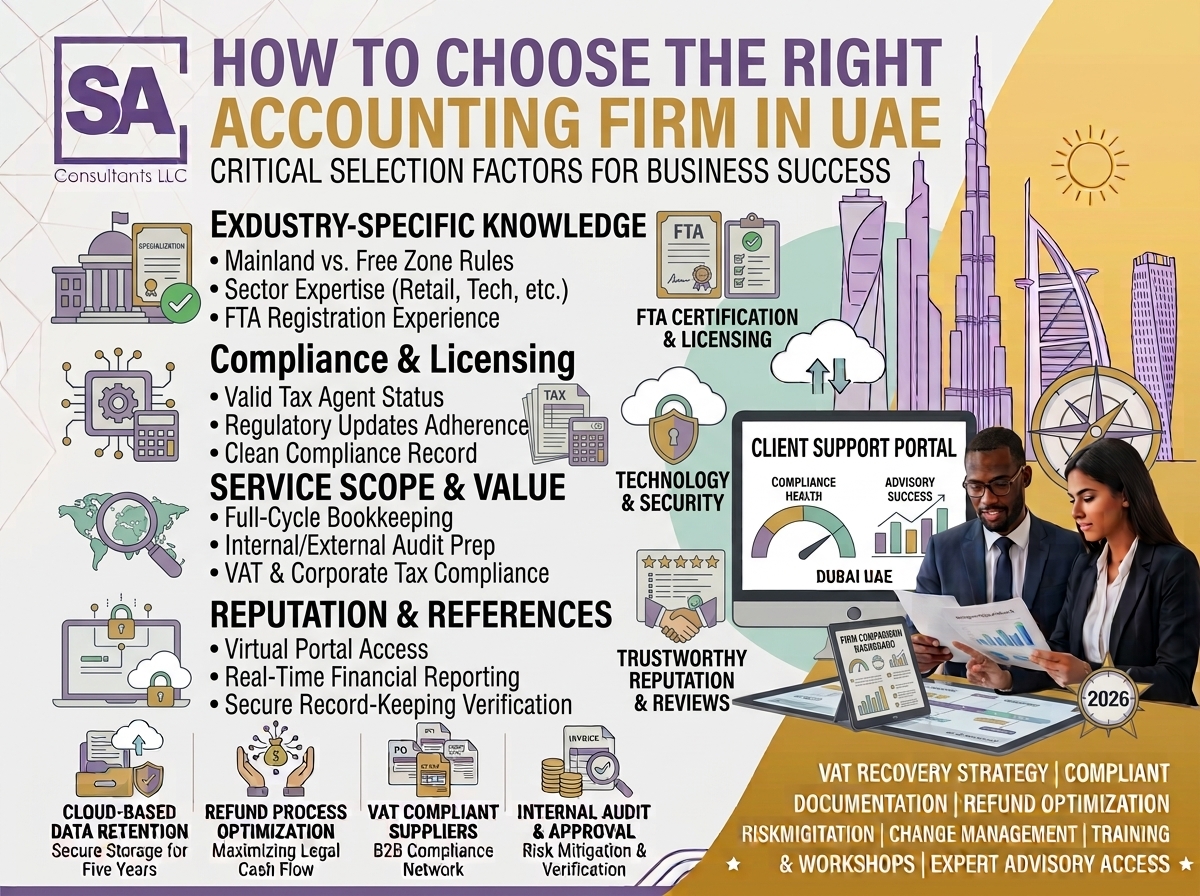
Before choosing an accounting provider in Dubai, businesses should check whether the service includes:
- Monthly bookkeeping
- Bank reconciliation
- Sales and purchase recording
- Accounts payable and receivable
- VAT-related transaction review
- Monthly profit and loss reporting
- Balance sheet preparation
- Cash-flow visibility
- Financial document organisation
- Corporate Tax support
- Accounting software management
- Year-end accounting support
The right scope depends on the size of the business, transaction volume, industry and tax obligations.
Accounting and Bookkeeping for Small Businesses in Dubai
Small businesses often do not need a full-time internal accounting department.
However, that does not mean financial management can be ignored.
A small company may have only a few employees but still process dozens or hundreds of transactions every month. As sales increase, financial records can quickly become difficult to manage manually.
For these businesses, outsourced accounting UAE services can provide access to bookkeeping, reconciliation and financial reporting without the cost of building a large internal finance team.
The key is to choose a service that matches the company’s actual transaction volume and reporting requirements rather than paying for unnecessary services.
When Should You Outsource Bookkeeping?
Outsourcing may be worth considering when:
- Bank reconciliation is falling behind
- Invoices are not being recorded consistently
- The owner is managing the books personally
- Customer balances are unclear
- Supplier payments are difficult to track
- VAT records require repeated corrections
- Management cannot see accurate monthly profit
- Corporate Tax preparation becomes difficult
- Financial records are only updated at year-end
A good outsourced bookkeeping process should reduce the amount of financial administration handled by the business owner while keeping the underlying records accessible and organised.
What Does Monthly Accounting Look Like?
A practical monthly accounting cycle can follow a simple process:
Collect → Record → Reconcile → Review → Report
First, financial documents and transaction information are collected.
Next, transactions are recorded in the accounting system.
Bank and other relevant accounts are reconciled.
The records are then reviewed for missing information, unusual transactions and classification issues.
Finally, management reports are prepared so the business owner can understand the financial position.
This approach is much easier to manage than trying to reconstruct an entire year’s transactions shortly before a tax or audit deadline.
How Much Do Accounting and Bookkeeping Services Cost in Dubai?
There is no single price that applies to every business.
Current Dubai market offerings vary according to transaction volume, VAT requirements, payroll, reporting requirements, accounting software and the amount of catch-up work required. Published 2026 market examples range from several hundred dirhams per month for smaller scopes to several thousand dirhams for more complex businesses.
When comparing quotations, businesses should look beyond the monthly price.
Ask:
What exactly is included?
A low monthly fee may not include VAT filing, financial reporting, reconciliation, payroll or historical bookkeeping cleanup.
Accounting and Bookkeeping Checklist for UAE Businesses
Before the end of each month, check that:
- All sales invoices have been recorded
- Purchase invoices are entered
- Business expenses have supporting documents
- Bank accounts are reconciled
- Customer balances are reviewed
- Supplier balances are checked
- VAT-related transactions are correctly classified
- Outstanding invoices are followed up
- Monthly profit and loss is reviewed
- Financial documents are securely stored
A consistent monthly process makes year-end accounting considerably easier.
Why Choose SA Consultants UAE for Accounting and Bookkeeping?
SA Consultants UAE provides accounting and bookkeeping support for businesses that need accurate records, organised financial reporting and ongoing accounting assistance.
The focus should not simply be on entering transactions. Your bookkeeping should help you understand the business, maintain cleaner financial records and prepare reliable information for your tax and financial reporting requirements.
Whether you need ongoing bookkeeping, bank reconciliation, financial reporting or broader accounting support, the service should be structured around your business size and actual requirements.
Frequently Asked Questions
What is included in bookkeeping services in Dubai?
Bookkeeping normally includes recording financial transactions, maintaining ledgers, bank reconciliation, accounts payable and receivable, expense tracking and organising financial records.
Is monthly bookkeeping necessary for a small business?
Monthly bookkeeping is useful because it keeps financial information current and reduces the amount of catch-up work required at tax or year-end reporting time.
What is the difference between an accountant and a bookkeeper?
A bookkeeper focuses primarily on recording and organising financial transactions. An accountant uses those records for financial reporting, analysis, tax-related work and broader financial management.
Can accounting and bookkeeping be outsourced?
Yes. Many UAE businesses outsource bookkeeping and accounting activities instead of maintaining a larger internal finance team.
How long should UAE Corporate Tax records be kept?
The FTA states that records and documents should generally be kept for at least seven years following the end of the relevant Corporate Tax period.
Should businesses reconcile their bank accounts every month?
Yes. Regular bank reconciliation helps identify missing transactions, duplicate entries and differences between the accounting records and bank statements.
What should I look for in an accounting service in Dubai?
Look for a service that covers the areas your business actually needs, including bookkeeping, reconciliation, reporting, tax support and proper financial record maintenance.
Final Takeaway
Accounting and bookkeeping should not be treated as a once-a-year exercise.
For Dubai businesses, maintaining accurate records throughout the year provides a clearer view of cash flow, profitability, customer balances and financial obligations. It also creates a stronger foundation for VAT and Corporate Tax reporting.
The best accounting setup is one that keeps your records current, reconciled, understandable and ready when you need them.
Need professional accounting and bookkeeping support in the UAE? Contact SA Consultants UAE to discuss a bookkeeping and accounting setup suited to your business.