Many businesses in the UAE do their bookkeeping throughout the month but never properly close the books.
Invoices are entered, expenses are paid and bank transactions appear in the accounting software, but nobody checks whether the numbers actually match.
That is where a proper month-end accounting checklist in the UAE becomes useful.
A monthly close does not need to be complicated. The objective is simple: make sure transactions are recorded correctly, accounts are reconciled, outstanding items are identified and management has reliable financial information before the next month begins.
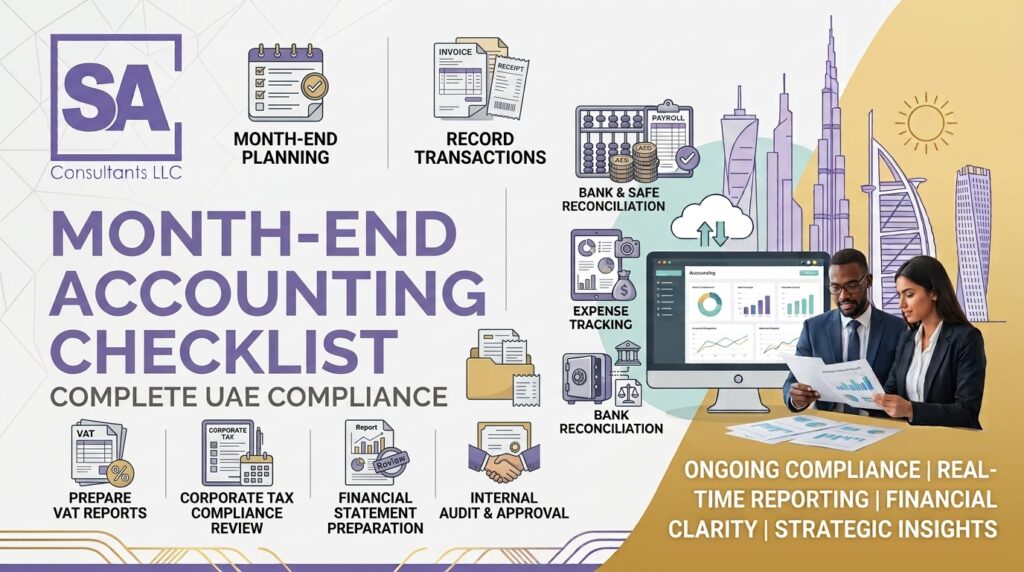
What Is a Month-End Accounting Close?
A month-end close is the process of reviewing and finalising a company’s financial records for a particular month.
For a UAE business, this can include:
- Recording all sales and purchase invoices
- Reviewing business expenses
- Reconciling bank accounts
- Checking accounts receivable
- Reviewing supplier balances
- Checking VAT-related transactions
- Recording payroll and other monthly costs
- Reviewing fixed assets and loans
- Preparing monthly financial reports
- Investigating unusual or unexplained transactions
The purpose is not simply to produce reports.
It is to make sure the reports are based on complete and reliable bookkeeping records.
1. Make Sure All Sales Are Recorded
Start with revenue.
Check that all invoices issued during the month have been entered into the accounting system. Credit notes, refunds and cancelled invoices should also be reviewed.
A difference between your invoicing system and accounting records can affect both your reported revenue and your tax calculations.
For businesses with a high number of transactions, this review should be part of the normal monthly bookkeeping process rather than something left until year-end.
2. Review Purchase Invoices and Expenses
Next, check whether all supplier bills and business expenses have been recorded.
Look for:
- Missing supplier invoices
- Duplicate invoices
- Unrecorded expenses
- Incorrect expense categories
- Personal expenses posted to the business
- Expenses without supporting documentation
Good bookkeeping services in Dubai should help businesses maintain an organised record of these transactions throughout the year.
3. Complete Bank Reconciliation
Bank reconciliation is one of the most important parts of the monthly close.
Compare the accounting ledger against the actual bank statement and identify differences.
These can include:
- Bank charges
- Transfers
- Unpresented payments
- Deposits not yet recorded
- Duplicate entries
- Missing transactions
- Incorrect transaction dates
If your bank balance and accounting balance do not make sense, management reports may also be unreliable.
4. Review Accounts Receivable
A profitable business can still experience cash-flow problems when customers pay late.
At month-end, review outstanding customer invoices and check:
- Which invoices are overdue?
- How long have they been outstanding?
- Are there disputed invoices?
- Are credit notes required?
- Which customers require follow-up?
A simple receivables ageing report can give management a much clearer picture of expected cash collections.
5. Check Accounts Payable
Supplier balances should also be reviewed.
Confirm that supplier invoices have been recorded correctly and that upcoming payments are visible.
This helps businesses avoid two common problems: missing payment deadlines and paying invoices twice.
For growing UAE businesses, proper accounts payable bookkeeping also makes monthly cash-flow planning easier.
6. Review VAT Bookkeeping
VAT-related transactions should be reviewed regularly rather than only when a VAT return is due.
Check that:
- VAT codes are applied correctly
- Tax invoices are available
- Credit notes are recorded
- Input VAT transactions have appropriate documentation
- Output VAT agrees with sales records
- Unusual transactions have been reviewed
The UAE Federal Tax Authority has also continued to update its guidance and legislation in 2026, making accurate underlying accounting records increasingly important for businesses managing their tax obligations.
7. Review Corporate Tax Records
Corporate Tax should not be treated as a once-a-year accounting exercise.
Your monthly bookkeeping should create a reliable trail of revenue, expenses, assets, liabilities and other transactions that may be relevant to Corporate Tax reporting.
The FTA published Decision No. 4 of 2026 concerning rules and requirements for maintaining information contained in accounting records and commercial books.
The FTA also continues to remind taxable persons about filing Corporate Tax returns and paying tax within the applicable statutory timeframe. For taxpayers whose financial year ended on 31 December 2025, the FTA’s September 2026 reminder stated that the return and payment were due before the end of September 2026.
Keeping the accounts updated monthly makes these annual requirements much easier to manage.
8. Prepare Monthly Financial Reports
Once the bookkeeping has been checked and reconciled, prepare management reports.
At a minimum, many businesses benefit from reviewing:
Profit and Loss Statement
Shows revenue, expenses and the resulting profit or loss for the period.
Balance Sheet
Shows the company’s assets, liabilities and equity.
Cash Flow
Helps management understand how money is moving through the business.
Receivables and Payables
Shows money expected from customers and amounts owed to suppliers.
These reports turn bookkeeping data into information that business owners can actually use.
9. Investigate Unusual Transactions
Do not simply close the month because every transaction has been entered.
Look for unusual movements such as:
- Large unexpected expenses
- Significant changes in gross margin
- Unusual supplier payments
- Unexpected customer refunds
- Large bank transfers
- Sudden increases in operating costs
A monthly review can identify problems much earlier than an annual financial review.
10. Store Supporting Documents Properly
Accounting records should be supported by appropriate documentation.
The FTA’s published material on tax obligations identifies records such as accounting entries, purchases, sales, profits, expenses, inventory records, financial statements, payroll records and fixed asset records among the types of documentation businesses may need to maintain.
A good bookkeeping system should therefore connect transactions with their supporting invoices, receipts, statements and other relevant documents.
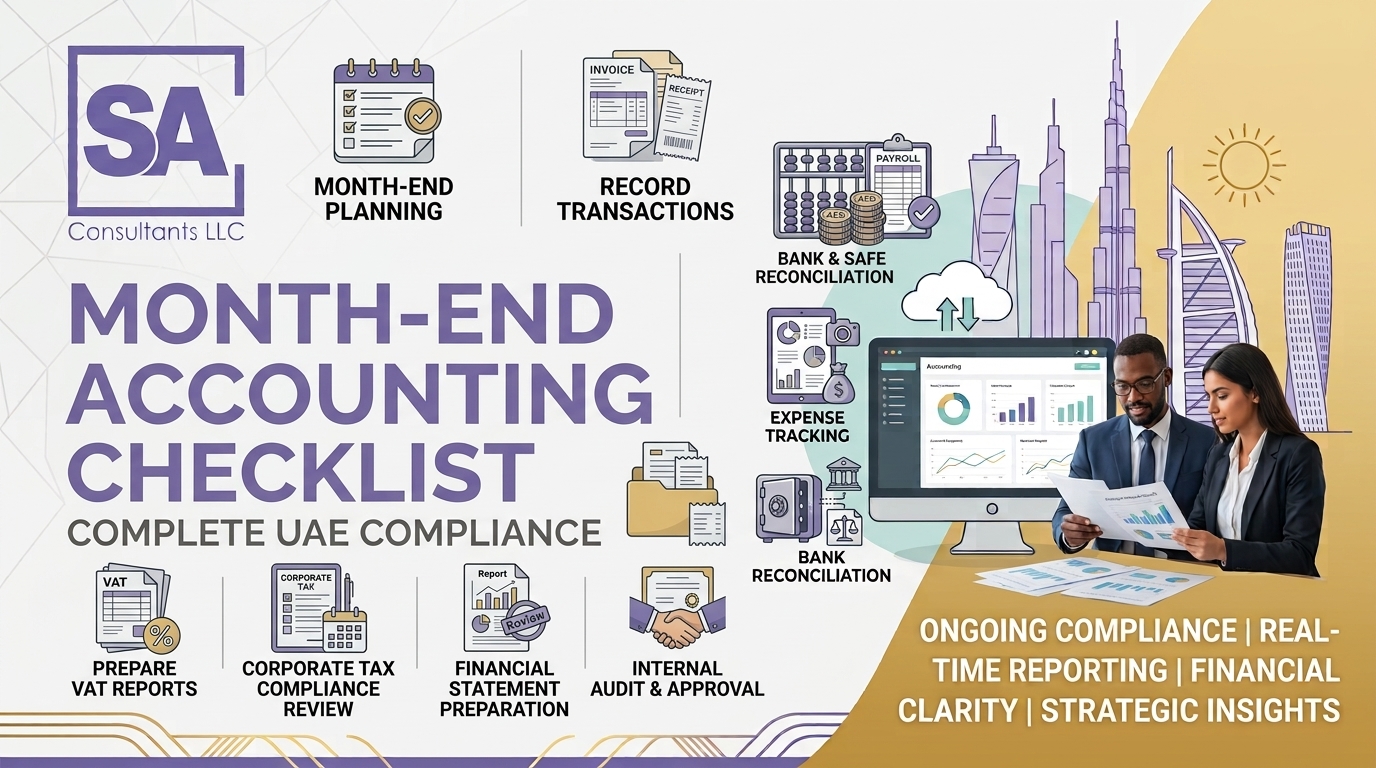
Simple Month-End Accounting Checklist
Before closing each month, ask:
Sales
- Are all invoices recorded?
- Are credit notes included?
- Are customer balances accurate?
Purchases
- Are supplier invoices complete?
- Are expenses properly categorised?
- Are supporting documents available?
Banking
- Are all bank accounts reconciled?
- Are unexplained differences resolved?
- Are bank charges recorded?
VAT
- Are VAT codes correct?
- Are tax invoices available?
- Have unusual VAT transactions been reviewed?
Corporate Tax
- Are financial records complete?
- Are major expenses supported?
- Are assets and liabilities properly recorded?
Reporting
- Is the monthly P&L reviewed?
- Is the balance sheet reasonable?
- Are receivables and payables under control?
- Does management understand the cash position?
When Should a UAE Business Outsource Bookkeeping?
Outsourcing can make sense when business owners are spending too much time entering transactions, reconciling accounts or preparing financial reports.
It can also help when:
- Bookkeeping is several months behind
- Bank reconciliation is not being completed regularly
- VAT records require frequent corrections
- Customer balances are unclear
- Management does not receive monthly financial reports
- Corporate Tax preparation becomes difficult
- The business is growing faster than its internal finance process
The important point is that outsourced accounting should not simply mean transaction entry.
A useful service should provide a structured monthly process that keeps the books accurate, reconciled and ready for reporting.
Accounting and Bookkeeping Support for UAE Businesses
For businesses in Dubai and across the UAE, accounting and bookkeeping work best when they operate as an ongoing monthly process.
SA Consultants UAE can support businesses with bookkeeping, accounting, reconciliation, financial reporting and tax-related accounting requirements.
Instead of waiting until the end of the year to understand the numbers, a monthly accounting process gives business owners regular visibility into revenue, expenses, cash flow and financial performance.
Frequently Asked Questions
What is a month-end accounting checklist?
A month-end accounting checklist is a structured process for reviewing transactions, reconciling accounts, checking tax-related records and preparing financial reports before closing the month.
Why is bank reconciliation important?
Bank reconciliation compares accounting records with actual bank transactions. It helps identify missing, duplicated or incorrectly recorded transactions.
How often should a UAE business update its bookkeeping?
For most businesses, updating bookkeeping monthly is a practical minimum. Businesses with high transaction volumes may need more frequent processing.
Does bookkeeping help with Corporate Tax?
Yes. Accurate bookkeeping provides the financial records needed to support tax calculations, reporting and documentation requirements.
Should VAT records be reviewed every month?
Regular VAT review helps identify incorrect tax codes, missing invoices and other issues before the VAT return preparation process.
Is outsourced bookkeeping suitable for small businesses?
It can be. Outsourcing allows a small business to access ongoing bookkeeping and accounting support without necessarily maintaining a large internal finance department.
What financial reports should a business review monthly?
Common monthly reports include the profit and loss statement, balance sheet, cash-flow information, accounts receivable ageing and accounts payable ageing.
Final Takeaway
A strong accounting system is not about waiting for year-end to find out what happened.
For UAE businesses, a simple monthly close process can keep bookkeeping organised, improve financial visibility and make VAT and Corporate Tax preparation easier.
The goal is straightforward:
Record accurately. Reconcile regularly. Review the numbers. Keep supporting documents.
That is what turns bookkeeping from a routine administrative task into a useful financial management process.