
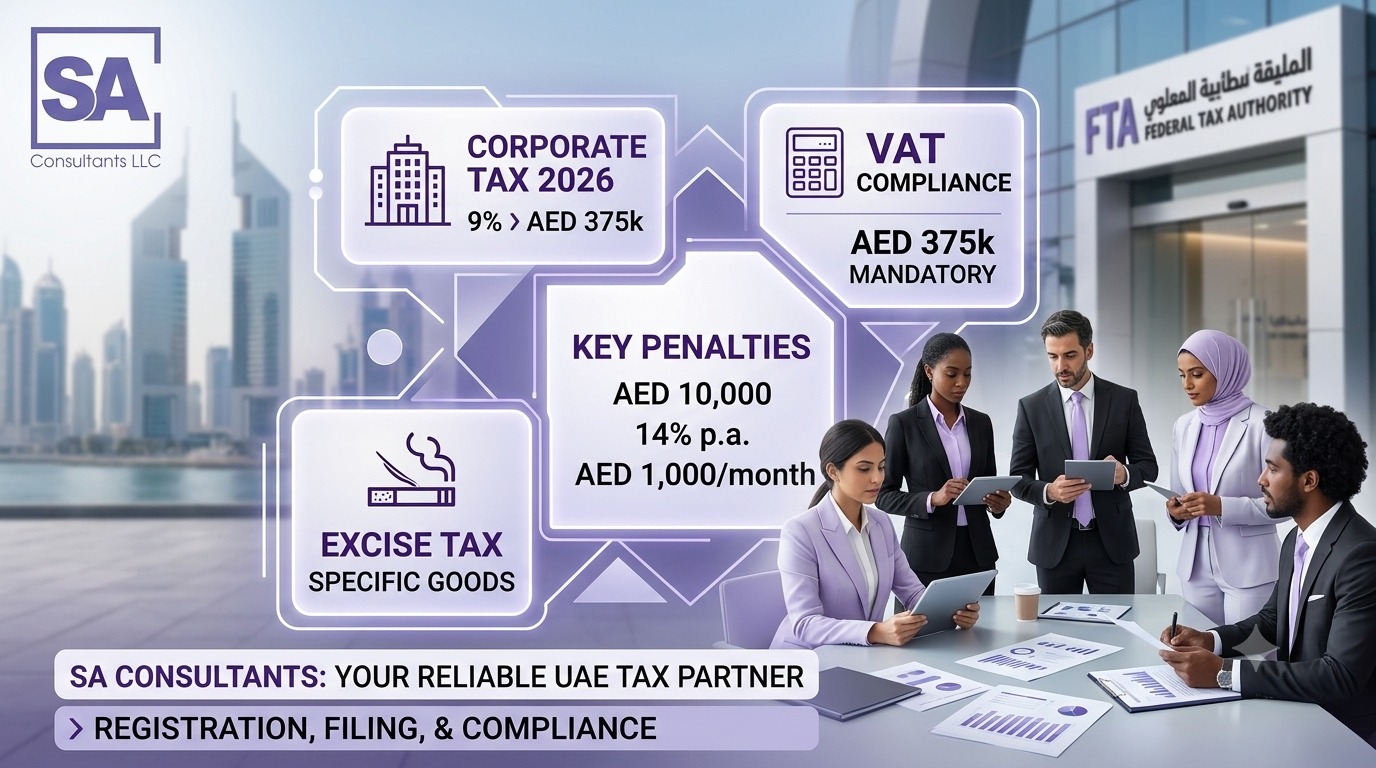
The UAE continues to strengthen its position as one of the world’s leading business destinations through a transparent and internationally aligned tax system. While the country’s tax framework remains highly competitive, businesses are now expected to meet stricter compliance obligations under Corporate Tax, Value Added Tax (VAT), and Excise Tax regulations.
Many founders believe that registering for tax is the final step. In reality, registration is only the beginning. Filing returns on time, maintaining accurate financial records, and meeting ongoing compliance obligations are equally important. Missing a deadline or misunderstanding a registration requirement can lead to financial penalties—even if your business has made no profit or no tax is payable.
Whether you are launching a startup, managing a growing SME, or operating an established company, understanding your obligations is essential for protecting your business and avoiding unnecessary compliance risks. This guide explains the registration criteria, filing requirements, and penalties applicable in 2026, helping you make informed decisions and remain fully compliant.
UAE Corporate Tax Registration 2026
Corporate Tax has become a fundamental part of doing business in the UAE. The tax framework is designed to support economic growth while aligning the country with global tax standards.
Corporate Tax registration generally applies to all UAE juridical persons, including Mainland companies and Free Zone entities. Natural persons, such as sole proprietors and freelancers, are also required to register if their business turnover exceeds the prescribed threshold. Businesses operating as Qualifying Free Zone Persons (QFZPs) may benefit from different tax rules where the applicable conditions are satisfied.
The UAE Corporate Tax structure remains highly competitive. Taxable income of up to AED 375,000 is subject to 0% Corporate Tax, while taxable income exceeding AED 375,000 is taxed at 9%.
However, registration alone does not fulfil your compliance obligations. Every registered business must submit its Corporate Tax Return within nine months after the end of its financial year. For example, a business with a financial year ending on 31 December 2025 must submit its return by 30 September 2026, while a business with a 30 June 2025 year-end must file by 31 March 2026.
A common misconception is that businesses with no taxable income or dormant operations are exempt from filing. This is incorrect. Even if no Corporate Tax is payable, your company has incurred losses, or your business remains inactive, a Corporate Tax Return must still be submitted within the prescribed deadline.
Failure to comply can result in significant penalties. Late Corporate Tax registration may attract a penalty of AED 10,000, although the Federal Tax Authority currently provides relief for certain late registrations where the first Corporate Tax Return is filed within seven months from the end of the first tax period. Late filing penalties begin at AED 500 per month during the first twelve months and increase to AED 1,000 per month from the thirteenth month onward. Businesses that delay payment of Corporate Tax may also incur 14% per annum on the outstanding tax.
UAE VAT Registration and Penalties
VAT remains one of the most actively monitored tax obligations for businesses operating in the UAE. Understanding the registration thresholds is essential for avoiding unnecessary penalties.
VAT registration becomes mandatory when a business reaches AED 375,000 in taxable turnover. Businesses with taxable turnover or eligible expenses of at least AED 187,500 may register voluntarily, allowing them to recover eligible input VAT and strengthen their financial credibility.
The registration threshold is determined using either the taxable supplies made during the previous twelve months or the expected taxable supplies within the coming thirty days.
Failure to register on time may result in a penalty of AED 10,000. Businesses that submit VAT Returns after the due date face a penalty of AED 1,000, increasing to AED 2,000 for repeated late filings within twenty-four months. Late VAT payments attract 2%, an additional 4%, and daily penalties as prescribed, while businesses that fail to deregister when required may face penalties of up to AED 10,000.
Maintaining organised financial records, accurate bookkeeping, and timely VAT filings remains the most effective strategy for reducing compliance risks.
Excise Tax Registration Requirements
Unlike Corporate Tax and VAT, Excise Tax applies only to businesses dealing in specific categories of goods considered harmful to health or the environment.
Registration is mandatory before carrying out excise activities involving tobacco products, energy drinks, carbonated drinks, sweetened beverages, and electronic smoking devices or liquids.
Businesses involved in manufacturing, importing, storing, or supplying these products must complete Excise Tax registration before commencing taxable activities.
Failure to register, submit returns, maintain required records, or provide accurate declarations may result in regulatory penalties. Depending on the nature of the violation, businesses may face fixed monetary fines together with tax-based penalties. Establishing proper compliance procedures before beginning excise activities helps minimise regulatory risk and ensures smooth business operations.
Key Tax Penalties Every UAE Business Should Remember
Understanding the financial consequences of non-compliance is just as important as understanding the registration process itself.
For Corporate Tax, late registration may result in an AED 10,000 penalty. Late return filing attracts AED 500 per month during the first year before increasing to AED 1,000 per month, while late tax payments incur 14% annual charges on outstanding tax.
For VAT, businesses should remember the AED 10,000 penalty for late registration, AED 1,000 for late VAT Return filing, AED 2,000 for repeated late filing within twenty-four months, and additional penalties for late payment or delayed deregistration.
Businesses subject to Excise Tax should ensure timely registration, accurate declarations, and proper record-keeping to avoid regulatory action.
The cost of compliance is always lower than the cost of corrective action.
Partner with SA Consultants for Reliable UAE Tax Compliance
Keeping pace with evolving tax regulations can be challenging, especially for growing businesses focused on expansion. At SA Consultants, we simplify complex tax requirements into practical, business-focused solutions that help you remain compliant while concentrating on growth.
Our specialists provide end-to-end support for Corporate Tax Registration, Corporate Tax Return Filing, VAT Registration, VAT Compliance, Excise Tax Advisory, Financial Statement Preparation, Transfer Pricing Assessments, and ongoing Federal Tax Authority (FTA) compliance.
Whether you’re registering a new company, reviewing your current compliance position, or preparing for upcoming filing deadlines, our experienced team provides practical guidance tailored to your business.
Don’t wait for penalties to highlight compliance gaps. Contact SA Consultants today and ensure your business meets every UAE tax obligation with confidence.