Setting up a company in Dubai has become much more than choosing a business name, getting a licence and opening an office.
For a new business owner, the decisions made before incorporation can affect banking, accounting, tax registration, invoicing, staffing, office requirements and the way the business operates months after the licence is issued. That is why many entrepreneurs are now looking beyond basic incorporation and working with company setup consultants Dubai businesses can rely on for a complete start-to-operate process.
One of the biggest changes in the UAE business environment is the growing importance of digital financial processes. The UAE is moving toward electronic invoicing, while Corporate Tax registration and reporting have become part of the normal financial responsibilities of many businesses. The Federal Tax Authority and Ministry of Finance continue to expand digital tax and invoicing processes, making it increasingly important to build proper accounting systems from the beginning.
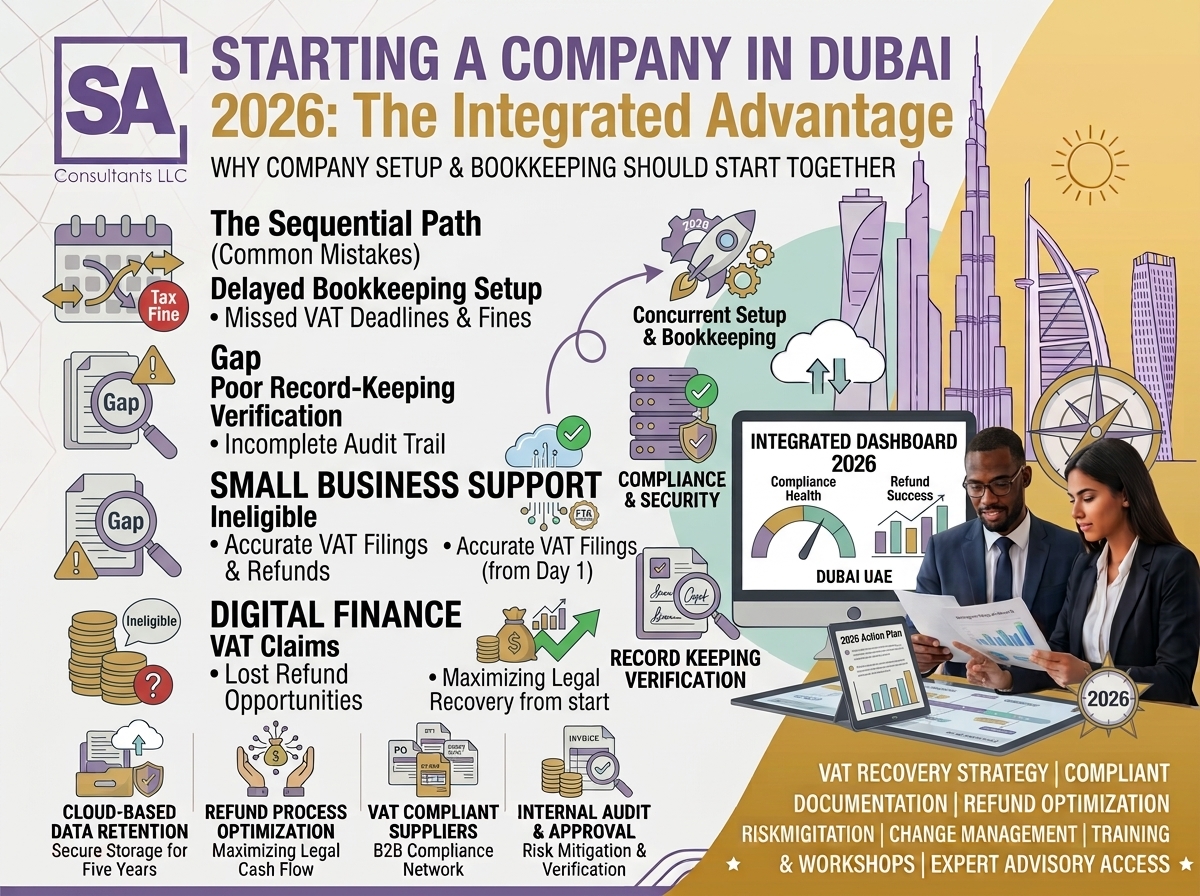
For an entrepreneur starting a new company, this means company formation and bookkeeping should not be treated as two completely separate jobs.
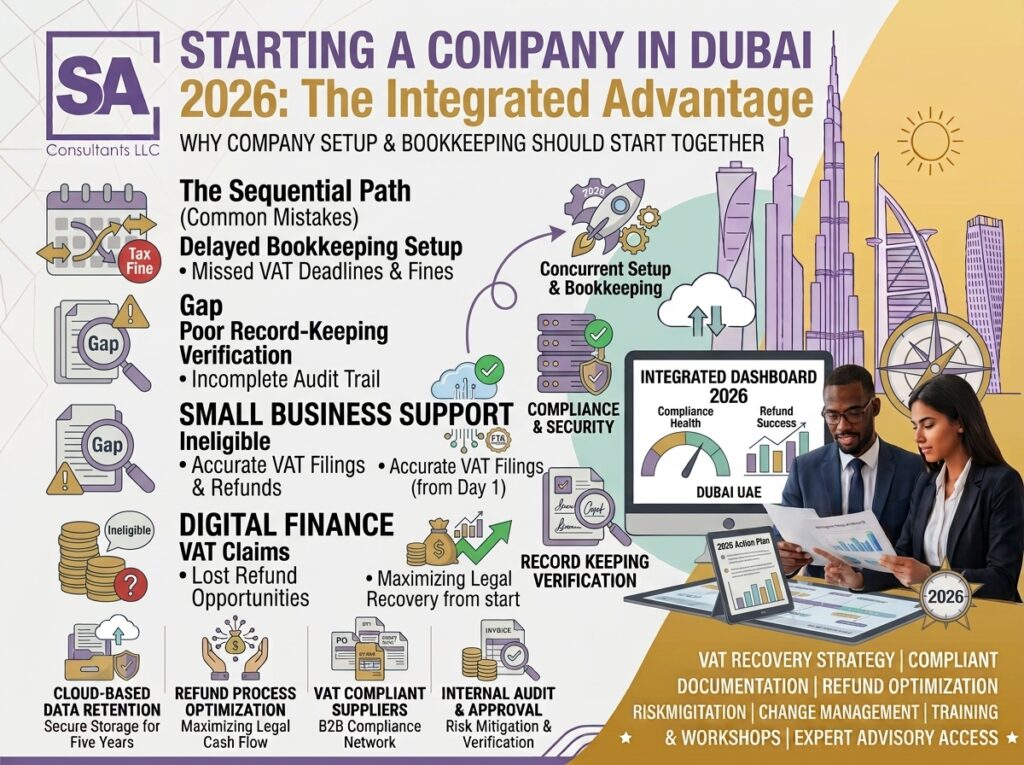
The licence creates the business.
Good bookkeeping creates the financial foundation that allows the business to operate, report and grow properly.
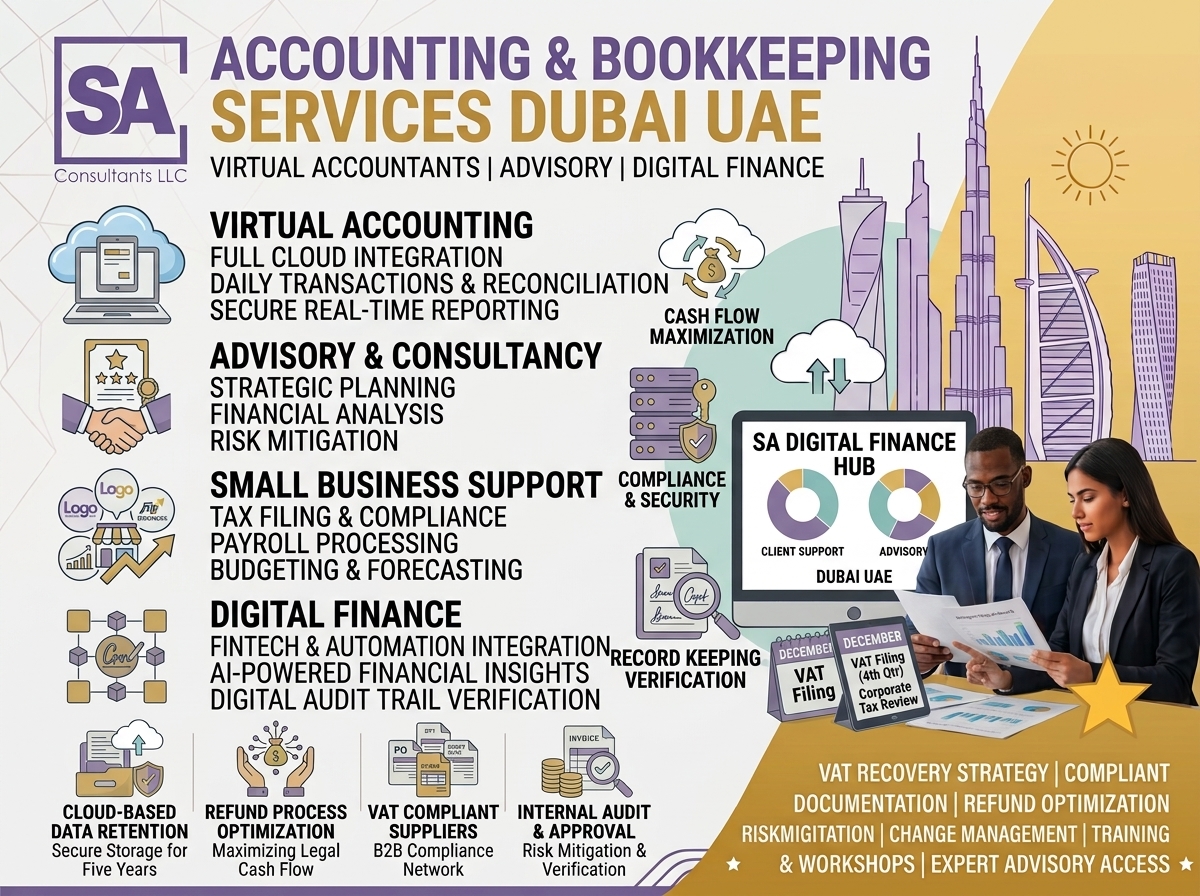
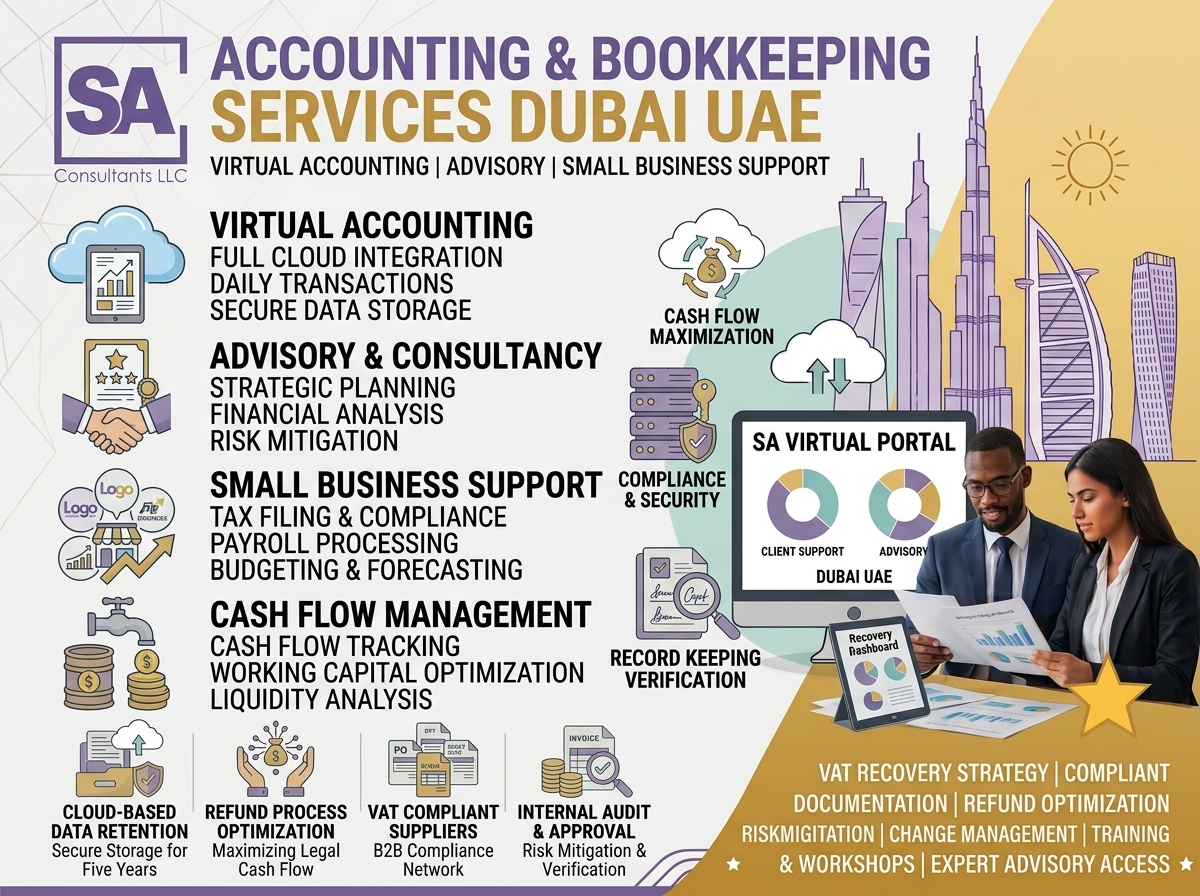
This is where SA Consultants UAE can support businesses with company setup guidance, bookkeeping, accounting, tax-related financial processes and ongoing business support in Dubai and across the UAE.
What Is the Trending Business Setup Approach in Dubai in 2026?
The traditional approach was simple: establish the company first and think about accounting later.
The more practical approach in 2026 is different.
Business owners are increasingly planning the structure, licence, financial workflow, accounting software, invoicing process and tax obligations together.
A typical modern setup can look like this:
Business idea
↓
Business activity selection
↓
Mainland or Free Zone decision
↓
Legal structure
↓
Trade name and licensing
↓
Banking and operational setup
↓
Accounting software
↓
Bookkeeping process
↓
VAT and Corporate Tax considerations
↓
Digital invoicing readiness
This approach reduces the risk of creating a company structure that looks suitable on paper but becomes difficult to manage once transactions begin.
The UAE Government’s official business setup guidance says mainland formation generally involves identifying the business activity, choosing a legal form, applying for a trade licence, registering the trade name, obtaining initial approval, preparing the required agreements, choosing a location and securing any additional government approvals that apply to the activity.
For free zones, the process also starts with selecting the business sector and a suitable free zone, followed by choosing the legal entity, trade name and licence requirements. Different free zones support different structures and activities.
That is why professional guidance should begin with understanding the business itself rather than simply asking, “How quickly can I get a licence?”
Why Company Setup and Bookkeeping Should Be Planned Together
A new business starts generating financial transactions almost immediately.
There may be incorporation expenses, office costs, subscriptions, employee payments, supplier invoices, customer invoices, marketing expenses and bank transactions.
If the accounting process is not established early, the owner can quickly end up with a collection of receipts, bank payments and invoices that need to be reconstructed later.
Professional bookkeeping services Dubai businesses use can prevent that situation by establishing a consistent financial process from the start.
When bookkeeping is planned from day one, businesses can create:
- A suitable chart of accounts
- Proper expense categories
- Customer and supplier records
- Bank reconciliation procedures
- Invoice tracking
- Document storage
- Monthly reporting
- Tax-ready financial records
- A repeatable year-end process
This is especially important for businesses that expect to grow quickly.
Company Setup Consultants Dubai: What Should They Actually Help With?
The phrase company setup consultants Dubai covers a wide range of services, and not every consultant provides the same level of support.
Some providers focus mainly on licence processing.
Others may help with incorporation, visas, office space and banking.
A broader business advisory approach can also look at what happens after incorporation.
Before setting up a business, a consultant should help the founder understand questions such as:
What business activity should be licensed?
Should the company operate on the mainland or in a free zone?
What legal structure fits the business model?
Will the company need physical office space?
Which approvals may be required?
What financial records should be maintained?
How should accounting software be selected?
What bookkeeping process should be followed?
What tax registrations may apply?
How will invoicing be handled as the company grows?
The objective is not to make setup complicated.
The objective is to avoid making important decisions without understanding their operational consequences.
Mainland or Free Zone? Start With the Business Model
One of the first major decisions for entrepreneurs is whether to establish a mainland company or a free zone company.
The UAE Government provides separate processes and guidance for mainland and free zone businesses. The official government portal notes that investors can establish mainland businesses online through available digital channels, while free zone companies are established through the relevant free zone authority.
Dubai’s official Invest in Dubai platform also describes mainland companies as businesses established outside free zones and notes that companies in Dubai mainland can operate within and outside the UAE, with 100% foreign ownership available in many sectors. Certain strategic activities remain subject to specific requirements or restrictions.
The right choice depends on the actual activity.
A consultancy, e-commerce business, trading company, technology company, professional service provider or industrial operation may have different licensing and operational requirements.
Instead of choosing a structure purely because somebody says it is cheaper, founders should consider:
- Where customers will be located
- Where the company will operate
- Whether employees will be required
- Whether physical premises are needed
- Whether the business needs warehouse facilities
- Whether the company expects local UAE operations
- The nature of the planned commercial activity
- Future expansion plans
This is one area where dubai company setup consultants can provide useful planning support before an application is submitted.
Bookkeeping Services Dubai: The Financial Foundation After Incorporation
Once the company has been established, the next challenge is keeping its financial information organised.
Bookkeeping services in Dubai can cover the regular recording and organisation of financial activity, including sales, purchases, expenses, receipts, invoices, payments, customer balances and supplier balances.
A good bookkeeping process does not have to be complicated.
For many SMEs, a monthly process can include:
Recording income
Customer invoices and incoming payments are recorded and matched correctly.
Recording expenses
Business costs are categorised and supported by appropriate documentation.
Bank reconciliation
The accounting system is compared with the actual bank transactions so differences can be identified and corrected.
Accounts receivable
Outstanding customer invoices are reviewed so management knows which amounts are still due.
Accounts payable
Supplier balances and upcoming payments are monitored.
Monthly reporting
Financial reports are prepared so the owner can understand revenue, expenses, profit and cash flow.
This creates a much clearer picture of the business than looking at the bank balance alone.
Bookkeeping Services in Dubai for Startups and SMEs
Startups frequently try to manage their own books during the first few months.
That can be reasonable when transaction volume is extremely low.
The problem often begins when the company starts growing.
Suddenly there are multiple suppliers, recurring software payments, marketing costs, employees, customer invoices, bank transfers and online transactions.
At that point, the owner may spend more time sorting financial records than running the business.
Professional bookkeeping services in Dubai allow business owners to delegate much of that routine work while retaining access to financial reports.
This can be particularly useful for:
- Technology startups
- Marketing agencies
- Consultants
- Online businesses
- E-commerce companies
- Professional service firms
- Trading businesses
- Real estate-related businesses
- Healthcare support businesses
- Small and medium enterprises
The accounting system should grow with the company rather than forcing the business to change financial processes every few months.
Why Digital Bookkeeping Is Becoming More Important
One of the biggest themes in UAE accounting in 2026 is digital integration.
The Ministry of Finance’s e-Invoicing programme is designed around structured electronic invoice data rather than ordinary PDF, Word, image or scanned invoices. The Federal Tax Authority specifically states that those unstructured formats are not e-Invoices under the UAE e-Invoicing definition.
This is relevant even for businesses that are still relatively small because accounting systems increasingly need to be prepared for electronic financial workflows.
The Ministry of Finance launched the UAE e-Invoicing 4-Corner Model in April 2026, allowing businesses to exchange electronic invoices through accredited channels and begin their onboarding process with an Accredited Service Provider.
The official guidelines also explain that e-Invoicing is intended to cover persons conducting business in the UAE, subject to specified exclusions and requirements.
For businesses, this makes accounting software selection a strategic decision instead of simply a bookkeeping convenience.
Company Setup Consultants UAE: Thinking Beyond Dubai
Dubai is the most common search location for many entrepreneurs, but the business setup process is relevant across the entire UAE.
That is why searches such as company setup consultants UAE can be more useful for entrepreneurs who are still deciding where their company should operate.
A business may compare Dubai with Abu Dhabi, Sharjah or another emirate based on its industry, customers, office requirements and growth plans.
Each emirate and free zone has its own authorities, licensing structures and processes.
The official UAE Government portal provides separate guidance covering mainland businesses and free zones across the UAE.
The important point is that the cheapest initial licence is not necessarily the most appropriate structure for every business.
Comparing Dubai and Abu Dhabi Business Setup
Entrepreneurs researching company setup consultants Abu Dhabi are often referring to company setup consultants in Abu Dhabi.
A comparison between Dubai and Abu Dhabi should consider the business activity rather than relying on generic claims about one location.
Dubai may make sense for businesses whose strategy is closely connected with Dubai’s commercial ecosystem, customer base and international business environment.
Abu Dhabi may be more relevant for businesses connected with particular industries, government-related opportunities, investment activities or Abu Dhabi’s own economic ecosystem.
The same principle applies to free zones.
The correct question is not simply:
“Which location is cheapest?”
A better question is:
“Which structure supports the way my business intends to operate?”
That distinction can save problems later.
Corporate Tax Is Now Part of the Setup Conversation
Company formation in the UAE can no longer be planned independently from financial compliance.
The Federal Tax Authority states that persons subject to Corporate Tax must register with the FTA and obtain a Corporate Tax Registration Number in accordance with the applicable rules. The FTA’s current Corporate Tax registration service provides the process through EmaraTax and lists documents such as incorporation documents, commercial registration information, trade licences and identification documents where applicable.
The FTA also continues to emphasise the importance of maintaining records supporting Corporate Tax filings.
In September 2026, the FTA reminded taxable persons whose financial year ended on 31 December 2025 that their Corporate Tax return and payment were due no later than 30 September 2026, consistent with the general rule that returns and payments are due within nine months from the end of the relevant Tax Period.
This illustrates why bookkeeping should begin early.
When financial information is recorded consistently throughout the year, preparing a tax return becomes a process of reviewing organised information rather than reconstructing twelve months of activity.
Corporate Tax and Small Businesses
Smaller businesses also need to understand how their accounting records relate to Corporate Tax.
The FTA currently describes Small Business Relief for eligible resident persons with revenue of AED 3 million or less in the relevant Tax Period and the previous Tax Periods that end on or before 31 December 2026, subject to the applicable conditions.
Eligibility is not something a business should assume simply because it considers itself a “small business.”
Revenue, residency, exclusions and other conditions need to be considered under the applicable rules.
Accurate bookkeeping therefore becomes important even when a business expects its tax burden to be limited.
Reliable records allow the company and its advisers to determine the correct treatment based on actual financial information.
Bookkeeping and E-Invoicing: Why the Connection Matters
A business may think of invoicing and bookkeeping as two separate processes.
In reality, they are connected.
A customer invoice creates accounting information.
That transaction may eventually affect receivables, revenue reporting, VAT-related records and tax calculations.
As electronic invoicing becomes part of the UAE’s financial environment, businesses need accounting systems that can work with structured invoice information and digital transaction workflows.
The Ministry of Finance’s official guidance provides phased implementation timelines. For businesses with annual revenue of AED 50 million or more, the mandatory implementation date is 1 January 2027, while businesses below AED 50 million have a mandatory implementation date of 1 July 2027. The Ministry later extended the Accredited Service Provider appointment deadline for persons subject to e-Invoicing with annual revenue above AED 50 million from 31 July 2026 to 30 October 2026, while retaining the 1 January 2027 implementation date.
For a new business, that means there is value in selecting accounting technology with future requirements in mind.
What Should a New Dubai Company Set Up Before Its First Sale?
A new company should ideally establish several basic financial controls before transaction volume becomes significant.
Business bank account and transaction structure
Business income and expenses should be separated from personal spending wherever possible.
Accounting software
Choose software that matches the company’s current needs and expected growth.
Invoice process
Create a consistent method for issuing, storing and tracking customer invoices.
Expense documentation
Business expenses should be supported by appropriate records.
Supplier records
Maintain clear information about suppliers and outstanding amounts.
Customer records
Track invoices and amounts due so cash collection does not become guesswork.
Monthly close
Set a regular date for reviewing and closing monthly accounts.
Financial reporting
Decide which reports the owner or management team needs each month.
Tax calendar
Record relevant registration, filing and payment dates.
These steps do not need to be expensive or complicated.
They need to be consistent.
Choosing the Right Accounting Software for a New Business
There is no single accounting platform that is perfect for every company.
The system should match the business model.
A consultancy might prioritise invoicing, expenses and professional reporting.
An e-commerce business may need better integration with online payment systems.
A trading company may require more detailed inventory and supplier management.
A growing company might need payroll, management reporting, project accounting and multiple users.
The most important question is not:
“What is the most popular accounting software?”
It is:
“What financial workflow does my business actually need?”
That is where professional bookkeeping services Dubai providers can help because they can review how transactions are actually occurring before recommending an accounting workflow.
Common Mistakes Entrepreneurs Make After Company Formation
Getting the company licence is only the beginning.
Several financial mistakes can create unnecessary work later.
Waiting until year-end to organise records
This creates a large backlog and makes it difficult to understand business performance during the year.
Mixing personal and business spending
This makes financial reporting harder to interpret.
Keeping invoices in random folders
Documents should be stored systematically so they can be located when required.
Choosing software without planning the workflow
Software should support the accounting process rather than become another administrative burden.
Ignoring bank reconciliation
A bank balance does not automatically mean that the accounting records are correct.
Assuming tax registration will take care of itself
Tax obligations should be considered early and monitored based on the company’s circumstances.
Treating company setup as a one-time event
Successful business setup is followed by ongoing compliance, accounting, reporting and operational management.
How SA Consultants UAE Can Support the Business Journey
For entrepreneurs looking for company setup consultants Dubai businesses can work with as their operations develop, the value of professional support is often in continuity.
The business should not have to explain its structure to one provider, its accounting to another and its tax records to someone else without coordination.
SA Consultants UAE can position its support around the wider business lifecycle.
That can include company setup guidance, ongoing bookkeeping, accounting support, financial reporting and tax-related accounting processes.
For a startup, the immediate priority may be getting the accounting structure right.
For an established SME, the priority may be monthly management accounts, reconciliations and better cash flow visibility.
For a company preparing for the UAE’s digital invoicing environment, the priority may be reviewing the existing accounting and invoicing workflow.
The service should reflect where the business is today and where it expects to go next.
A Practical 2026 Checklist for New UAE Businesses
Before starting operations, a founder can work through the following checklist:
Business activity selected
Mainland or free zone structure reviewed
Legal form confirmed
Trade name checked
Required approvals identified
Licence application completed
Office or business address requirements reviewed
Business banking planned
Accounting software selected
Bookkeeping workflow established
Invoice process prepared
Customer and supplier records organised
Corporate Tax requirements reviewed
VAT position assessed where applicable
Financial document storage established
Monthly reporting schedule agreed
E-Invoicing readiness considered
This checklist brings together company formation and financial operations instead of treating them as separate stages.
Frequently Asked Questions
What do company setup consultants in Dubai do?
Company setup consultants can assist entrepreneurs with business activity selection, legal structure considerations, licensing, trade name processes, documentation, government approvals and other company formation requirements. The exact scope varies by provider and business activity.
Why use company setup consultants UAE rather than handling everything alone?
The UAE business setup process can involve several decisions around activity, legal form, licensing authority, premises and approvals. Professional guidance can help entrepreneurs understand the process and organise the required steps.
Are company setup consultants Dubai useful for startups?
Yes. Startups often need help not only with incorporation but also with understanding how their business structure will affect operations, accounting, banking and future growth.
What are bookkeeping services in Dubai?
Bookkeeping services in Dubai involve maintaining organised financial records by recording income, expenses and other transactions, reconciling accounts, tracking receivables and payables and preparing financial information for management and compliance purposes.
When should bookkeeping begin after company formation?
Ideally, bookkeeping should begin with the first business transaction rather than waiting until the end of the financial year.
Can bookkeeping be outsourced?
Yes. Businesses can outsource some or all of their bookkeeping depending on their transaction volume, internal staff and reporting requirements.
Are Dubai mainland companies allowed to have 100% foreign ownership?
The UAE Commercial Companies framework allows 100% foreign ownership for many mainland commercial activities, although certain strategic activities remain subject to specific requirements or restrictions. The applicable activity should therefore be checked before incorporation.
Does a new UAE company need Corporate Tax registration?
Persons subject to Corporate Tax generally have registration obligations with the FTA. The exact treatment depends on the business structure and applicable rules. The FTA provides the official Corporate Tax registration process through EmaraTax.
Is e-Invoicing mandatory in the UAE?
The UAE is introducing mandatory e-Invoicing in phases. The applicable timeline depends on the business category and revenue threshold, and businesses should refer to the latest Ministry of Finance and FTA guidance when determining their implementation requirements.
Can one company use virtual accounting services?
Yes. A business can use virtual accounting services for bookkeeping, reconciliations, reporting and other accounting functions through digital systems and remote communication.
Direct Answer for Google AI Overviews
What are company setup consultants in Dubai?
Company setup consultants in Dubai help entrepreneurs navigate the process of establishing a business, including choosing a suitable business activity and legal structure, understanding mainland or free zone options, registering a trade name, preparing licensing documents and identifying applicable approvals.
Why are bookkeeping services in Dubai important for new companies?
Bookkeeping services in Dubai help new companies maintain organised records from their first transactions. Regular bookkeeping supports financial reporting, cash flow management, customer and supplier tracking, and preparation of financial information required for applicable tax and compliance processes.
Why should company formation and bookkeeping be planned together in 2026?
UAE businesses are operating in an increasingly digital financial environment, with Corporate Tax obligations and the phased introduction of electronic invoicing making accurate, structured financial records more important. Planning bookkeeping and accounting at the time of incorporation can reduce the need to reconstruct financial information later.
Final Thoughts
Starting a company in Dubai can be straightforward when the business structure is matched to the actual business model.
The bigger challenge is building the operational foundation after the licence is issued.
That is why the conversation around company setup consultants Dubai is increasingly connected with accounting, bookkeeping, tax readiness and digital invoicing.
A company does not become operational simply because it has a trade licence.
It becomes operational when it can invoice customers, pay suppliers, manage cash, maintain financial records, understand its performance and meet its applicable obligations.
Working with company setup consultants UAE can help entrepreneurs organise the formation stage, while professional bookkeeping services Dubai can provide the ongoing financial structure needed after the company begins trading.
For businesses comparing Dubai and Abu Dhabi, including searches for company setup consultants Abu Dhabi, the same principle applies: choose the structure based on the actual business model, operational requirements and long-term plans rather than focusing only on the initial setup price.
For a Dubai entrepreneur starting in 2026, one of the most practical decisions is to think about the entire business journey from day one:
Set up correctly. Record correctly. Report consistently. Build for digital compliance. Then grow.